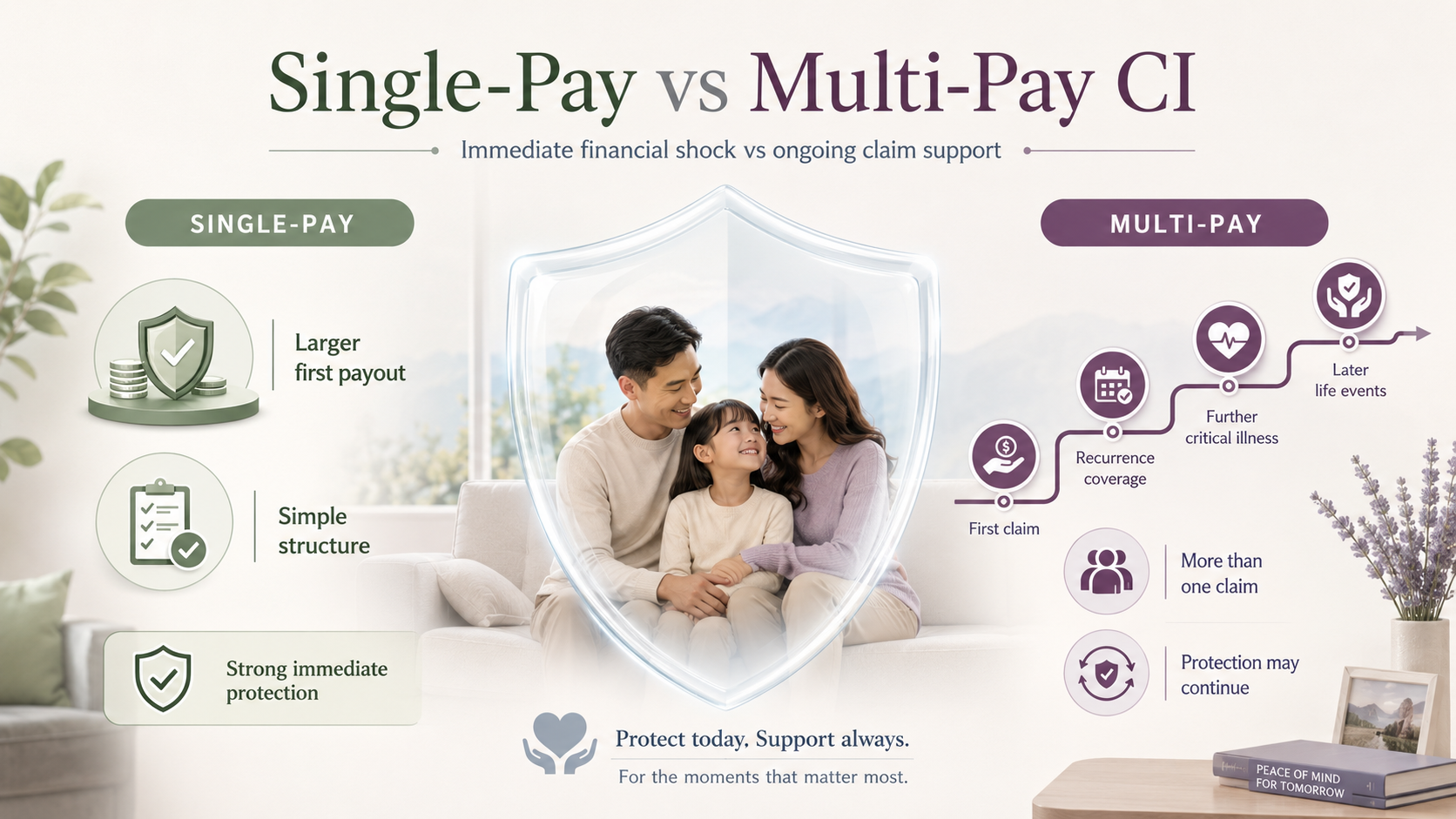

Critical illness insurance is often described as either single-pay or multi-pay.
The basic difference is:
- Single-pay CI generally provides one main payout after a qualifying critical illness claim.
- Multi-pay CI may provide more than one payout across different illness stages, different illnesses or recurrence scenarios, subject to the policy’s limits and conditions.
Multi-pay coverage is not automatically better because it can pay more than once.
Single-pay coverage is not automatically inadequate because it usually pays only once.
The more important questions are:
How much would you receive from the first serious claim, what protection remains afterwards, and how much can you afford without sacrificing the coverage amount you need?
MoneySense explains that conventional critical illness insurance generally pays a one-time lump sum, while some policies allow smaller earlier-stage payouts or several payments for different insured illnesses, subject to the sum insured and policy limits. MoneySense — Understanding Critical Illness Insurance (MoneySense)
Interested to learn more?
Fill in the form below and we will get back to you!
Single-pay vs multi-pay CI at a glance
| Feature | Single-pay CI | Multi-pay CI |
|---|---|---|
| Number of potential claims | Generally one main CI payout | More than one claim may be possible |
| First-event coverage | Often prioritises a larger initial payout | May divide benefits across several potential claims |
| What happens after a claim | Relevant benefit may end or reduce | Some coverage may continue |
| Recurring illness coverage | Usually not available after full payout | May be available if policy conditions are met |
| Different subsequent illnesses | Usually no further CI payout after full claim | May allow further claims from eligible illness groups |
| Complexity | Usually simpler | Usually more complex |
| Premium | Depends on the product; simpler cover may cost less | Additional claim features may increase cost |
| Main strength | Stronger focus on the first major financial shock | Continued protection against more than one qualifying event |
| Main risk | No CI protection may remain after the full claim | First payout may be insufficient despite a high advertised total |
These are general structural differences. Actual claim limits, illness categories and remaining benefits must be checked against the policy contract.
What does single-pay critical illness insurance mean?
“Single-pay” is a common description rather than a standardised policy label.
In this article, it refers to a structure where the relevant CI benefit is generally exhausted after the full qualifying payout.
For example, someone has:
S$300,000 of severe-stage single-pay CI coverage
If they suffer a qualifying severe-stage illness and the full S$300,000 is paid, the CI benefit may end.
Where the CI coverage is attached to a life policy as an accelerated rider, the payout may also reduce the base death benefit. MoneySense notes that where a rider accelerates the basic policy benefit, the policy may expire after the rider is fully paid. MoneySense — Health Insurance Terms (MoneySense)
This does not mean every single-pay policy works identically.
Interested to learn more?
Fill in the form below and we will get back to you!
Some may include:
- Partial early-stage benefits
- Additional benefits for specified procedures
- Remaining severe-stage coverage after an earlier partial claim
- Premium-waiver benefits
- Separate benefits that do not reduce the main sum assured
The actual outcome depends on the contract.
What does multi-pay critical illness insurance mean?
Multi-pay CI allows more than one qualifying payout under the same policy, subject to its benefit structure.
A policy may provide additional claims for:
- Different critical illnesses
- Different illness groups
- Progression from an earlier to a later stage
- Recurrence of a previously claimed illness
- Specified recurring cancers
- Additional severe-stage events
However, multi-pay does not mean unlimited claims.
A policy may restrict claims through:
- Maximum total payout
- Limits for each illness group
- Limits for the same illness
- Required periods between claims
- Recurrence definitions
- Treatment-free or remission requirements
- Survival requirements
- Exclusions after an earlier claim
- Expiry ages for particular benefits
-
Interested to learn more?
Fill in the form below and we will get back to you!
MoneySense confirms that some policies permit several payments for different insured illnesses, but these remain subject to the policy’s sum insured and limits. (MoneySense)
The LIA framework does not standardise multi-pay structures
The LIA Critical Illness Framework 2024 standardises the severe-stage definitions of 37 listed critical illnesses where the framework applies.
It allows insurers to decide which medical conditions and illness stages their plans cover. Earlier-stage and extremely severe definitions may be designed by the insurer. LIA Critical Illness Framework 2024 (Lia)
The framework does not standardise:
- Whether a plan is single-pay or multi-pay
- Maximum aggregate payouts
- Recurrence benefits
- The number of claims permitted
- Illness-group restrictions
- Waiting periods between claims
- Early or intermediate-stage definitions
- Whether one payout reduces another benefit
Two multi-pay plans can therefore behave very differently even when both use the same LIA severe-stage definitions.
The first payout may matter more than the maximum advertised payout
A multi-pay plan may advertise total potential payouts of 300%, 500% or more of its base sum assured.
That headline does not reveal how much is available from the first claim.
Consider two simplified structures.
Interested to learn more?
Fill in the form below and we will get back to you!
Plan A: Single-pay
- Severe-stage CI benefit: S$300,000
- Maximum CI payout: S$300,000
- Full benefit ends after payment
Plan B: Multi-pay
- Base CI benefit: S$150,000
- Maximum aggregate payout: S$450,000
- Further claims depend on policy conditions
Plan B has the higher theoretical maximum.
But after the first qualifying severe-stage illness:
- Plan A may pay S$300,000
- Plan B may initially pay S$150,000
Plan B becomes more valuable only if a later event qualifies for another payout.
This is an author-created illustration. It shows why maximum aggregate benefit and first-event protection should be compared separately.
Why the first serious illness deserves priority
The first qualifying illness can create the immediate financial shock:
- Income stops or falls
- Medical leave begins
- Mortgage payments continue
- Savings start being used
- A spouse may reduce work
- Rehabilitation or caregiving begins
- Future insurability may be affected
If the initial payout is too small, the possibility of future claims may not solve the household’s immediate cash-flow problem.
This is why the correct starting question is not:
How many times can this policy pay?
It is:
How much money would my household require after the first major claim?
Interested to learn more?
Fill in the form below and we will get back to you!
When single-pay CI may be more suitable
Single-pay coverage may deserve greater consideration when:
- A large first-event payout is the main priority
- The household has a significant coverage shortfall
- Premium affordability is important
- The coverage is intended mainly for income replacement
- A mortgage and young dependants create a large temporary need
- The person already has other long-term resources
- A simple policy structure is preferred
For someone who needs S$400,000 of immediate CI protection, purchasing a sufficiently large single-pay benefit may be more useful than buying a smaller multi-pay plan solely because its theoretical aggregate payout is higher.
When multi-pay CI may be more suitable
Multi-pay coverage may deserve greater consideration when:
- Continued CI protection after the first claim is important
- The person is concerned about more than one qualifying event
- Recurrence protection is valued
- Earlier-stage and later-stage benefits are both priorities
- The additional premium is comfortably affordable
- The first payout remains sufficient for the household’s needs
- Existing single-pay coverage already provides a strong foundation
The value lies in continued protection after a claim, not merely in having a larger percentage printed in the brochure.
Interested to learn more?
Fill in the form below and we will get back to you!
Does multi-pay CI cover cancer recurrence?
It may—but not automatically.
A policy may define recurrence based on matters such as:
- Whether the later cancer is a recurrence or a new primary cancer
- How long the insured must remain free of signs or treatment
- Whether the recurrence occurs after a specified interval
- Whether the original cancer has progressed, spread or returned
- Whether the later diagnosis meets the required severity
- Whether the policy’s recurrence benefit remains in force
A later cancer diagnosis does not automatically produce another payment simply because the plan is described as multi-pay.
The recurrence wording must be read carefully.
Can you claim for a different illness after the first claim?
Potentially.
For example, a multi-pay policy may allow a later claim for heart attack after a previous cancer claim.
But the answer depends on:
- Whether both conditions are covered
- Whether they fall within separate claim groups
- Whether the maximum number of claims has been reached
- Whether the required period between claims has passed
- Whether the first claim reduced or ended another benefit
- Whether the second illness meets its contractual definition
A multi-pay label alone does not confirm that every combination of illnesses is claimable.
Interested to learn more?
Fill in the form below and we will get back to you!
How do early-stage claims affect later benefits?
An early-stage payout may be:
Accelerated
The payment reduces the benefit available for a later severe-stage claim.
Example:
- Original severe-stage benefit: S$200,000
- Early-stage payout: S$50,000
- Remaining severe-stage benefit: S$150,000
Additional
The early-stage benefit is paid without reducing the main severe-stage sum assured.
Part of a multi-pay limit
The payment counts towards the plan’s maximum total payout.
Restricted to one claim group
The early-stage payment may reduce or remove further protection for related conditions.
These are general illustrations. The exact treatment must be verified from the policy schedule and contract.
Multi-pay does not necessarily mean better early-stage coverage
Single-pay and multi-pay describe how many claims may be made.
They do not, by themselves, reveal:
- Which early-stage illnesses are covered
- How broad the definitions are
- How much an early-stage claim pays
- Whether the payout is accelerated or additional
- How much severe-stage protection remains
- Whether multiple early-stage claims are possible
A multi-pay plan can still have restrictive earlier-stage definitions.
A single-pay plan may offer a strong early-stage benefit.
The structure and the definitions must be assessed separately.
What happens to the death benefit after a CI claim?
This depends on whether the CI benefit is accelerated or additional.
Accelerated benefit
The CI payout reduces the life policy’s death benefit.
For example:
- Death benefit before claim: S$500,000
- Accelerated CI payout: S$200,000
- Remaining death benefit: potentially S$300,000
Interested to learn more?
Fill in the form below and we will get back to you!
Additional benefit
The CI payout does not reduce the base death benefit, subject to the policy terms.
Both single-pay and multi-pay designs may use accelerated or additional benefits.
Do not assume multi-pay automatically preserves the full death benefit.
A high maximum payout may be difficult to reach
A multi-pay plan’s maximum aggregate benefit usually assumes that several separate claim requirements are met over time.
Reaching the maximum may require:
- Multiple qualifying diagnoses
- Survival between claims
- The required intervals to pass
- The policy remaining in force
- No applicable exclusions
- Each later illness satisfying its own definition
- Claim limits not already being exhausted
The maximum benefit should therefore be treated as a contractual ceiling—not a likely payout forecast.
Compare:
- The amount payable from the first realistic claim
- The amount remaining afterwards
- The conditions required for later payments
- The absolute maximum across the policy
How should premiums be compared?
Do not compare premiums without matching the benefits.
Check whether the quotations use the same:
- Initial severe-stage sum assured
- Early-stage amount
- Coverage expiry age
- Premium-payment period
- Smoker status
- Policy type
- Accelerated or additional structure
- Claim limits
- Premium-waiver benefits
A multi-pay plan may cost more because it keeps some protection available after a claim.
But a cheaper plan is not automatically better if its first payout is insufficient, and a more expensive plan is not automatically better if later claims are difficult to access.
MoneySense advises comparing insurance benefits, features and coverage rather than selecting a product based only on premiums. MoneySense — Insurance Basics (MoneySense)
Interested to learn more?
Fill in the form below and we will get back to you!
An illustrative budget comparison
Assume someone can afford S$250 per month.
They are comparing:
Option A
- Higher single-pay severe-stage benefit
- No further CI payout after the full claim
Option B
- Lower first-event benefit
- Further payouts possible after qualifying later events
The correct choice depends on whether Option B’s first payout can already support:
- Essential household expenses
- Mortgage repayments
- Dependants
- Income disruption
- The intended recovery period
If not, the person may be paying for future optionality while leaving the first and most immediate financial shock underinsured.
Can single-pay and multi-pay coverage be combined?
Yes.
A layered structure may use:
A larger single-pay foundation
This addresses the immediate income and household need after the first severe illness.
A smaller multi-pay layer
This preserves some protection for a later qualifying illness or recurrence.
For example:
- S$300,000 single-pay CI foundation
- S$100,000 multi-pay coverage for additional events
This is an author-created illustration, not a product recommendation.
A combined approach may provide a stronger first payout while retaining some future protection. However, it also increases premiums and policy complexity.
Interested to learn more?
Fill in the form below and we will get back to you!
Should you buy multi-pay coverage because people can develop more than one illness?
The possibility of a later illness is relevant, but it should not replace a proper needs assessment.
Before paying more for multi-pay features, ask:
- Is the first-event coverage already sufficient?
- Do I understand which later claims are permitted?
- Is recurrence genuinely covered?
- How long must I wait between claims?
- What is the maximum for each illness group?
- Does the plan remain affordable over the full term?
- Am I sacrificing too much initial protection to obtain future claims?
The purpose is not to maximise the number of possible payouts.
It is to build adequate and usable protection.
A practical comparison checklist
1. First qualifying payout
How much is payable for the first severe-stage claim?
2. Remaining protection
What CI coverage remains after that payment?
3. Early-stage interaction
Does an early-stage payout reduce the severe-stage benefit?
4. Different-illness claims
Can you claim later for a condition from another illness group?
5. Same-illness recurrence
What conditions must be met before recurrence is covered?
6. Maximum aggregate benefit
Is the advertised maximum realistic only after several separate claims?
7. Waiting and survival requirements
What time and medical conditions apply between claims?
8. Death-benefit interaction
Does the CI payout reduce the life insurance benefit?
9. Expiry age
How long do the first and subsequent-claim benefits remain available?
10. Premium sustainability
Can the policy be maintained without compromising more essential protection?
Interested to learn more?
Fill in the form below and we will get back to you!
Common mistakes
Choosing multi-pay only because the maximum payout is higher
The first claim may pay much less than the advertised aggregate maximum.
Assuming all later illnesses qualify
Illness groups, intervals and claim limits may restrict further payments.
Buying too little initial protection
The household may remain exposed after the first and most financially disruptive illness.
Assuming single-pay means no early-stage benefit
Some single-pay structures include partial earlier-stage coverage.
Assuming multi-pay preserves the full death benefit
The CI benefits may still be accelerated from the base policy.
Comparing only the number of covered illnesses
The payout amounts, definitions and remaining protection matter more than the headline count.
Frequently asked questions
Is multi-pay CI always better than single-pay CI?
No.
Multi-pay provides the possibility of further claims, but single-pay may provide a larger first-event benefit for the available budget.
Does multi-pay CI pay every time I become seriously ill?
No.
Each claim must meet the policy’s definitions, limits and conditions.
Can I claim twice for cancer?
Possibly, where the policy includes cancer recurrence or subsequent-cancer benefits and the required conditions are met.
Can I claim for cancer and later for heart attack?
Potentially, depending on the illness-group structure, intervals, remaining benefits and policy definitions.
Does an early-stage claim reduce my later severe-stage payout?
It may. Check whether the earlier benefit is accelerated, additional or counted towards an aggregate limit.
Do I need multi-pay coverage if I already have single-pay CI?
Not automatically. First establish whether your existing coverage is sufficient for the initial financial shock. Multi-pay may then be considered as an additional layer.
Should I replace a single-pay policy with multi-pay coverage?
Not automatically.
Replacement may involve new underwriting, exclusions, waiting periods, higher premiums and the loss of existing contractual benefits. Supplementing an existing plan may sometimes be more appropriate.
Interested to learn more?
Fill in the form below and we will get back to you!
Final thoughts
Single-pay CI focuses on providing money for the first qualifying financial shock.
Multi-pay CI aims to keep some protection available for subsequent qualifying events.
The right comparison is not:
One payout or many payouts?
It is:
How much is available from the first claim, what remains after it, and how realistic are the conditions for receiving more?
A multi-pay policy with an impressive maximum benefit may still leave the first claim underfunded.
A single-pay policy may provide strong immediate protection but leave nothing for a later illness.
The most suitable structure balances:
- Adequate first-event coverage
- Continued protection
- Clear claim conditions
- Affordable premiums
- The duration of your financial responsibilities
Would the first payout protect your household—or are you relying on claims that may never happen?
A multi-pay plan can look comprehensive because of its maximum advertised payout. But that amount may depend on several illnesses occurring years apart and meeting separate contractual rules.
A proper comparison can reveal how much cash you would actually receive from the first claim, what coverage remains afterwards and whether adding multi-pay protection would strengthen your plan—or simply make it more expensive.
This article is for general information only and does not constitute personalised financial advice. Coverage, claim eligibility and suitability depend on individual circumstances and the applicable policy terms.