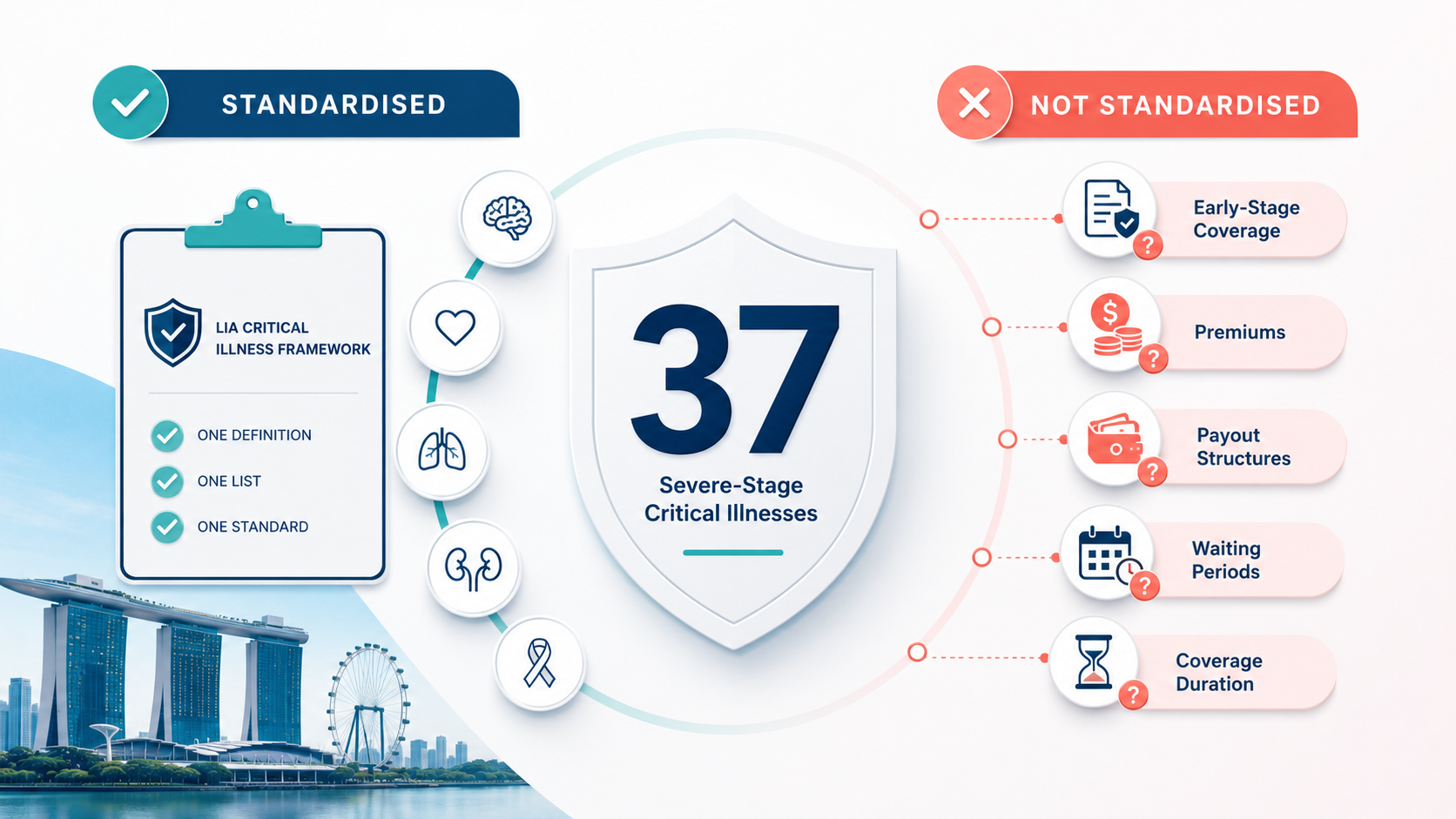

The LIA Critical Illness Framework creates a common set of severe-stage critical illness definitions for Singapore insurers.
Its central purpose is straightforward:
When insurers cover one of the 37 listed critical illnesses at the severe stage, consumers should begin with a consistent medical definition rather than completely different definitions from every insurer.
However, the framework does not make every critical illness policy identical.
It does not standardise all early-stage conditions, premiums, payout structures, waiting periods, multiple-claim benefits or coverage durations.
Understanding this distinction is essential when comparing critical illness insurance in Singapore.
Two policies may both refer to the LIA Critical Illness Framework while still offering very different protection.
Interested to learn more?
Fill in the form below and we will get back to you!
What is the LIA Critical Illness Framework?
The LIA Critical Illness Framework 2024 provides guidance on the provision of critical illness benefits by member companies of the Life Insurance Association Singapore and the General Insurance Association of Singapore.
The Monetary Authority of Singapore was informed of the amendments.
The framework contains:
- Operational rules for insurers
- A common list of 37 severe-stage critical illness definitions
- Rules governing when insurers must adopt those definitions
- Implementation rules for Version 2024
- Disclosure requirements
- Guidance for existing policies, policy renewals and coverage top-ups
The framework aims to balance consumer clarity with insurers’ ability to design different products. (lia.org.sg)
Interested to learn more?
Fill in the form below and we will get back to you!
What does the LIA Critical Illness Framework standardise?
The framework standardises the severe-stage medical definitions of 37 listed critical illnesses.
These include conditions such as:
- Major Cancer
- Heart Attack of Specified Severity
- Stroke with Permanent Neurological Deficit
- End Stage Kidney Failure
- Coronary Artery By-pass Surgery
- Coma
- Deafness
- Major Organ or Bone Marrow Transplantation
- Terminal Illness
- Loss of Independent Existence
The full list and medical definitions are contained in LIA CI Framework 2024 Part 2. (lia.org.sg)
Standardising the definition means that where the framework applies, insurers use the same core medical criteria for that severe-stage condition.
For example, the common definition may specify:
- The required medical diagnosis
- The severity threshold
- The procedure that must have taken place
- How long an impairment must persist
- The medical evidence required
- Which conditions or circumstances are excluded from that definition
It does not mean the illness is covered merely because it has been diagnosed.
The diagnosis must still meet the definition stated in the applicable policy contract.
Interested to learn more?
Fill in the form below and we will get back to you!
Why were common CI definitions introduced?
Without common definitions, insurers could use materially different medical thresholds while placing the same illness name on their products.
A consumer comparing two policies might see “Stroke” listed under both plans but may not be able to identify subtle differences in:
- Required neurological impairment
- Persistence periods
- Medical tests
- Exclusions
- Specialist confirmation
- Claim evidence
The LIA framework seeks to give consumers a more consistent starting point.
Its objectives include:
- Making severe-stage coverage clearer
- Supporting comparison between CI policies
- Improving consumer confidence
- Reducing differences caused solely by insurers using different severe-stage definitions
- Supporting more consistent claims outcomes
However, common definitions do not guarantee identical claim outcomes.
Each insurer still assesses the medical evidence and facts presented for the individual claim. LIA’s industry FAQ states that one insurer paying a claim does not necessarily mean another insurer must also pay, although use of the same definition should generally support more consistent outcomes.
Why does LIA standardise only the severe stage?
The framework does not standardise every stage of every illness.
LIA explains that severe-stage critical illnesses remain the core and most commonly covered CI benefits.
Reinsurance research cited in LIA’s industry FAQ found that five illness groups accounted for close to 90% of severe-stage claims received by insurers:
- Major Cancer
- Heart Attack of Specified Severity
- Stroke
- Other heart diseases
- Kidney failure
The research cited was Gen Re’s Dread Disease Survey covering 2015 to 2019.
By standardising the severe stage while allowing insurers to define other stages, the framework seeks to balance:
- Consistency for the core CI benefit
- Product flexibility
- Competition
- Development of early and intermediate-stage coverage
LIA also noted that early-stage CI coverage is a more recent product development and that more experience and analysis would be required before standardisation could be considered.
Interested to learn more?
Fill in the form below and we will get back to you!
What does the framework not standardise?
The framework does not standardise every aspect of a CI policy.
| Feature | Standardised by LIA? |
|---|---|
| Severe-stage definitions of the 37 listed CIs | Yes, where the framework applies |
| Early-stage CI definitions | No |
| Intermediate-stage CI definitions | No |
| Extremely severe-stage definitions | No |
| Conditions outside the list of 37 | No |
| Number of conditions covered | No |
| Sum assured | No |
| Premium | No |
| Coverage duration | No |
| Premium payment term | No |
| Single-claim or multiple-claim design | No |
| Recurrence or relapse benefits | No |
| Accelerated or additional payout structure | No |
| Policy-level waiting period | No |
| Survival period | No |
| Waiver benefits | No |
| Product presentation and layout | No |
Some medical exclusions form part of the standard severe-stage definition itself.
However, other policy exclusions, contractual conditions and benefit mechanics may still differ between insurers.
This is why the phrase “uses LIA definitions” does not mean two plans provide identical coverage.
Interested to learn more?
Fill in the form below and we will get back to you!
Early-stage CI definitions remain insurer-specific
An insurer may offer benefits for:
- Early-stage cancer
- Intermediate-stage cancer
- Less severe heart conditions
- Less severe neurological conditions
- Specified procedures
- Additional insurer-defined medical conditions
These definitions are created by the insurer rather than standardised by the LIA severe-stage framework.
For example, two insurers may both cover early-stage cancer but use different criteria for:
- Which tumours qualify
- Required staging
- Treatment requirements
- Exclusions
- Payout percentages
- Whether an early claim reduces later severe-stage coverage
The policy contract must therefore be checked.
Consumers should not assume that early-stage CI coverage is standardised merely because the policy also includes the 37 LIA severe-stage conditions.
Conditions outside the list of 37 are not standardised
Insurers may cover medical conditions that are not included in LIA’s list.
For those conditions, the insurer uses its own definition at every stage.
Examples may include insurer-specific:
- Early-stage conditions
- Juvenile illnesses
- Gender-specific illnesses
- Complications of pregnancy
- Diabetic complications
- Additional neurological conditions
- Special procedures
The framework specifically states that products designed for men, women or children may fall outside its scope where they do not cover any of the listed conditions within their entire coverage.
The presence of additional conditions may broaden a product’s scope, but the number of conditions alone does not show how useful the coverage is.
The definition, payout and eligibility requirements remain important.
Does every CI plan need to cover all 37 illnesses?
No.
An insurer may choose to cover:
- All 37 listed conditions
- A smaller selection
- A single condition
- The 37 conditions plus additional insurer-defined conditions
The previous industry maximum of 30 medical conditions per CI plan was abolished in November 2014.
There is no requirement for every policy to contain the same number of illnesses.
What the framework controls is the applicable severe-stage definition when an insurer chooses to cover one of the listed conditions and the framework requires that common definition to be adopted.
This means:
A plan covering more illnesses is not automatically better than one covering fewer illnesses.
Consumers should also examine:
- The conditions most relevant to major claims
- The sum assured
- The benefit structure
- Coverage duration
- Affordability
- Whether payouts overlap
- Whether coverage remains after a claim
Interested to learn more?
Fill in the form below and we will get back to you!
When must an insurer use an LIA severe-stage definition?
Where an insurer includes one of the listed medical conditions as a severe-stage benefit, it must generally adopt the LIA common definition for that condition.
The framework also permits insurers to make minor wording changes for consistency with their own terminology, provided the changes do not alter the coverage defined by LIA.
For example, an insurer may use:
- “Life Insured” instead of “Life Assured”
- “Dread Disease” instead of “Critical Illness”
- “Early Stage” instead of “Mildly Stage”
These wording adjustments must not change the medical scope of the standard definition.
The important exception for all-stage products
There is an important technical exception.
Suppose a product covers a condition across all stages and pays the same benefit regardless of severity.
In that situation, the LIA severe-stage definition may not apply because the policy does not use the severe stage as a separate benefit tier.
The framework gives the example of a cancer product that pays the same benefit for cancer at any covered stage.
However, where the product pays different benefit levels according to severity, the severe-stage benefit must use the LIA common definition where applicable.
This distinction explains why a product can cover a familiar condition without necessarily following the LIA severe-stage definition in every circumstance.
The actual contract remains the source of truth.
Interested to learn more?
Fill in the form below and we will get back to you!
What changed under Version 2024?
The Version 2024 review sought to update the previous Version 2019 definitions in line with:
- Changes in medical technology
- Current diagnostic practices
- Developments in medical science
- Areas of ambiguity identified through industry experience
The review resulted in:
- 7 revised definitions
- 30 unchanged definitions
- 2 revised condition headers
The seven definitions updated were:
- Major Cancer
- Coma
- Deafness
- Open-Heart Heart Valve Surgery
- Terminal Illness
- Persistent Vegetative State
- Other Serious Coronary Artery Disease
Interested to learn more?
Fill in the form below and we will get back to you!
The two revised headers were:
- Open Chest Heart Valve Surgery to Open-Heart Heart Valve Surgery
- Open Chest Surgery to Aorta to Surgery to Aorta
The Open-Heart Heart Valve Surgery change included both a header and definition revision.
The Surgery to Aorta change involved the header, while the underlying definition remained unchanged.
The fact that seven definitions changed does not mean Version 2024 is universally better or worse for every policyholder.
Some changes clarified intended coverage, while others changed medical or evidentiary wording.
Each condition must be considered separately.
When did Version 2024 take effect?
Since 1 October 2025:
- New products launched from that date must use the amended Version 2024 definitions.
- Products using Version 2019 definitions may no longer be sold in Singapore.
For individual policies, the applicable version is generally determined by the proposal signed date.
Proposals signed by 30 September 2025 could be issued under Version 2019 only if the policy was issued by 31 December 2025.
For group policies, the version is based on the CI policy effective date. Group policies newly effected or renewed on or after 1 October 2025 are to carry Version 2024 definitions. (lia.org.sg)
Were existing CI policies automatically changed to Version 2024?
No.
An existing policy continues to be governed by the definitions, terms and conditions in its contract.
The latest definitions are not applied retrospectively merely because they are newer.
LIA’s industry FAQ states that:
- Existing CI policies are not automatically updated.
- Existing early-stage CI policies and riders are not automatically changed.
- Policyholders cannot simply request that old definitions be replaced by the latest definitions.
- Reinstating a lapsed policy does not automatically move it to the latest definitions.
- Claims are assessed using the definition stated in the relevant policy contract.
This contractual certainty protects both parties from the policy terms changing unilaterally after issue.
Interested to learn more?
Fill in the form below and we will get back to you!
Can a top-up use a different definition version?
Potentially.
For a top-up to an existing CI policy, the insurer has discretion to:
- Apply the existing definition version to the increased amount, or
- Apply the prevailing definition version to the increased amount
Where the prevailing definition is used, the insurer should disclose this to the policyholder.
This can result in one policy containing two portions of coverage governed by different definition versions.
For example:
- Original S$100,000 governed by Version 2019
- Later S$50,000 top-up governed by Version 2024
A future claim may then be assessed separately against each applicable definition.
This is one reason policyholders should retain:
- Policy schedules
- Endorsements
- Top-up documents
- Supplementary benefit documents
- Product summaries
Does standardisation mean all claims will have the same outcome?
No.
The framework standardises the applicable definition, but every claim still depends on its own facts and evidence.
Insurers may receive different:
- Medical reports
- Test results
- Specialist opinions
- Dates of diagnosis
- Treatment records
- Information about exclusions
- Policy histories
Interested to learn more?
Fill in the form below and we will get back to you!
LIA’s industry FAQ specifically states that payment by one insurer does not automatically require another insurer to pay.
Each insurer assesses the claim based on:
- The medical facts
- The policy contract
- The applicable definition version
- The evidence submitted
- Other contractual conditions
Standardisation provides the same starting medical definition where applicable.
It does not guarantee an identical outcome in every claim.
Why a diagnosis does not automatically mean a claim
Critical illness insurance does not generally pay simply because a doctor has used the name of a listed illness.
The condition must meet the contractual severity threshold.
For example:
- A cancer may be diagnosed but fall within an excluded early or non-invasive category under the severe-stage definition.
- A stroke may occur but require evidence of permanent neurological deficit after the specified assessment period.
- Kidney disease may be serious but may not meet the requirement for permanent dialysis or kidney transplantation.
- A heart condition may require specific medical evidence or the actual undergoing of a covered procedure.
This does not mean the illness is medically unimportant.
It means the insurance definition is designed to identify the contractual stage or severity at which the stated benefit becomes payable.
What happened to the standard 90-day waiting period?
The framework no longer imposes one common 90-day waiting period across CI policies.
From 16 November 2022, member insurers were allowed to determine suitable waiting periods for their own policies.
The framework’s medical definitions are intended to address the clinical scope of the conditions rather than dictate every payment or policy mechanic.
Waiting periods may therefore differ between insurers and products.
Consumers should check:
- When the waiting period starts
- Which conditions it applies to
- Whether different benefits have different periods
- What happens if diagnosis or symptoms arise during that period
Interested to learn more?
Fill in the form below and we will get back to you!
What happened to the S$25,000 angioplasty cap?
The previous standard S$25,000 cap for Angioplasty and Other Invasive Treatment for Coronary Artery was removed from 9 March 2022.
LIA explained that common definitions should focus on consistent medical coverage rather than standardising the payment amount.
Insurers may therefore determine their own benefit amounts and structures for this coverage, subject to the applicable product contract.
This reinforces the difference between:
- Standardising the medical claim trigger
- Standardising how much a policy pays
The first may fall within the framework.
The second generally remains a product decision.
Why two plans using LIA definitions may still be very different
Consider two hypothetical plans that both cover the same 37 severe-stage conditions.
Plan A
- S$300,000 severe-stage coverage
- No early-stage benefit
- Single claim
- Coverage to age 70
- Benefit accelerates the death benefit
Interested to learn more?
Fill in the form below and we will get back to you!
Plan B
- S$150,000 severe-stage coverage
- S$75,000 early-stage benefit
- Multiple-claim structure
- Coverage to age 85
- Some benefits may be additional
Both may use the same LIA severe-stage definitions.
Yet they differ materially in:
- How much they pay
- When they may pay
- Whether a payout reduces another benefit
- Whether coverage continues
- How many claims may be made
- How long the protection lasts
- How much the premiums cost
These are author-created illustrations.
The applicable mechanics must be verified from the individual product documents.
What should you check when comparing CI plans?
1. Severe-stage definitions
Check:
- Which LIA definition version applies
- Whether all 37 conditions are included
- Whether any listed conditions are absent
- Whether the benefit uses the standard severe-stage definition
2. Early and intermediate-stage definitions
Check:
- Conditions covered
- Medical thresholds
- Payout percentages
- Exclusions
- Whether an early claim reduces later coverage
These stages are generally insurer-defined.
3. Payout structure
Establish whether benefits are:
- Accelerated
- Additional
- Partial
- Single-claim
- Multiple-claim
- Recurrence-based
Interested to learn more?
Fill in the form below and we will get back to you!
4. Maximum usable benefit
Do not add every headline figure together automatically.
Check whether:
- One payout reduces another
- Death coverage is reduced
- Claims share one overall limit
- Benefits remain after a previous claim
5. Coverage duration
A plan may end at:
- A fixed age
- The end of a term
- The first claim
- The exhaustion of its maximum benefit
6. Waiting and survival periods
These may differ by insurer, benefit and condition.
7. Policy version
The applicable version may depend on:
- Proposal signed date
- Group policy effective date
- Renewal date
- Top-up date
- Original contract wording
What should appear in the product summary?
Insurers are required to state the critical illnesses covered in the product summary.
Interested to learn more?
Fill in the form below and we will get back to you!
For group business, the disclosures are to appear in the quotation sheet provided to the prospective corporate client.
However, the presentation format is not standardised.
This means important information may appear differently across:
- Product summaries
- Benefit illustrations
- Policy schedules
- Rider documents
- Definition booklets
- Group quotations
Consumers should not rely only on a marketing brochure or list of condition names.
The policy contract and supplementary benefit documents remain important.
Common misunderstandings about the LIA framework
“Every CI plan covers the same 37 illnesses.”
Not necessarily.
Insurers may select the number of conditions covered, subject to the framework’s adoption rules.
“Early CI definitions are the same across insurers.”
No.
The framework standardises only the severe stage of the 37 listed conditions.
“A newer definition version must always be better.”
No.
Each revision must be assessed individually. Version 2024 should not be treated as universally broader or more favourable.
Interested to learn more?
Fill in the form below and we will get back to you!
“One insurer paying means every insurer must pay.”
No.
Each claim is assessed under its own policy contract and medical evidence.
“My old policy automatically received the new definitions.”
No.
Existing policies remain governed by their contractual terms unless the contract itself permits a change.
“More conditions means better protection.”
Not automatically.
The amount, definitions, payout structure, duration and affordability may matter more than the headline condition count.
“The framework decides how much insurers must pay.”
Generally no.
The framework standardises applicable severe-stage medical definitions, not premiums or standard benefit amounts.
Frequently asked questions
Is the LIA Critical Illness Framework a type of insurance policy?
No.
It is an industry framework governing common severe-stage definitions and related operational requirements.
Individual insurers still design and issue their own policies.
Does LIA insure or pay critical illness claims?
No.
Claims are assessed and paid by the insurer that issued the policy, according to the policy contract.
Are all 37 conditions severe-stage conditions?
The LIA common definitions describe the severe stage of the 37 listed medical conditions.
Are early-stage cancer definitions standardised?
No.
Early, intermediate and other non-severe stages are generally defined by individual insurers.
Do all insurers charge the same premium for LIA-defined coverage?
No.
Only the applicable severe-stage definitions are standardised. Insurers may differ in pricing, underwriting, service and product design.
Interested to learn more?
Fill in the form below and we will get back to you!
Which definition version applies to my policy?
It depends on the policy’s issue history and contract.
For individual Version 2024 policies, the proposal signed date was the key transition reference. For group coverage, the CI policy effective date applied.
Existing policies generally continue under the definitions stated in their contracts.
Can an old policy and a new policy use different definitions?
Yes.
Policies purchased at different times may use different definition versions.
Each claim is assessed under the relevant policy contract.
Should I replace an old policy to obtain Version 2024 definitions?
Not automatically.
Replacement may involve new underwriting, exclusions, higher premiums, waiting periods or the loss of existing contractual benefits.
The entire policy—not only the definition version—should be reviewed before any replacement decision.
Interested to learn more?
Fill in the form below and we will get back to you!
Final thoughts
The LIA Critical Illness Framework gives Singapore consumers a common foundation for severe-stage CI coverage.
It standardises:
- The severe-stage definitions of 37 listed conditions
- When insurers must adopt those definitions
- Certain operational and disclosure requirements
It does not standardise:
- Early and intermediate-stage definitions
- All additional conditions
- Premiums
- Payout amounts
- Multiple-claim structures
- Waiting and survival periods
- Coverage duration
- Every policy exclusion or benefit interaction
The framework therefore makes comparison easier—but it does not make comparison unnecessary.
The real question is not simply:
Does my policy use LIA definitions?
It is:
Beyond those standard severe-stage definitions, how much would my policy actually pay, at which stages, for how long—and what coverage remains after a claim?
The same 37 definitions can still hide very different levels of protection
Two CI policies may both display the LIA 37-condition list, yet one could provide far less usable protection because of lower benefits, shorter coverage, early-stage limitations or payouts that reduce other benefits.
A detailed policy review can reveal which definition version applies, how your benefits interact and whether the headline coverage would genuinely support your household after a serious diagnosis.
This article is for general information only and does not constitute personalised financial advice. Claim eligibility and benefits depend on the applicable policy contract and individual circumstances.
Sources
- Life Insurance Association Singapore — LIA Critical Illness Framework 2024
- LIA CI Framework 2024 — Part 1: Operational Framework
- LIA CI Framework 2024 — Part 2: Definitions for 37 Critical Illnesses
- LIA CI Framework 2024 — Part 3: Version 2019 and Version 2024 Comparison
- LIA CI Framework 2024 — Part 4: Summary of Changes
- LIA Critical Illness Framework — Industry FAQ