Last Updated on by Tree of Wealth
The Life Insurance Association Singapore’s Protection Gap Study uses an assumed five-year critical illness recovery period when estimating how much financial support an economically active adult may need following a serious illness.
This five-year period is sometimes misunderstood.
It does not mean that every critically ill person will be hospitalised, undergoing treatment or unable to work for exactly five years.
It is a population-level modelling assumption used to estimate household expenses, debt repayments and other financial needs during recovery.
According to LIA’s Protection Gap Study 2022, the recovery period refers broadly to the time from critical illness diagnosis until the individual is able to return to work.
Actual recovery may be much shorter—or considerably longer.
Interested to learn more?
Fill in the form below and we will get back to you!
What does “critical illness recovery period” mean?
In the Protection Gap Study, the critical illness recovery period was used as a financial-planning timeframe.
It was not limited to:
- Time spent in hospital
- The duration of surgery
- Active medical treatment
- Medical leave stated on a certificate
- The point when a doctor declares treatment complete
A person may be discharged from hospital but still be unable to resume normal work.
They may need time for:
- Chemotherapy or radiotherapy
- Rehabilitation
- Physiotherapy
- Follow-up procedures
- Managing treatment side effects
- Rebuilding physical strength
- Psychological recovery
- Adjusting to permanent limitations
- A gradual return to employment
Someone may therefore be medically stable without being financially or occupationally recovered.
Interested to learn more?
Fill in the form below and we will get back to you!
Does LIA assume everyone stops working for five years?
No.
LIA’s Protection Gap Study 2022 Public FAQ recognises that actual outcomes can vary widely.
Following a critical illness, a person may:
- Continue working throughout treatment
- Take several weeks or months of medical leave
- Stop working temporarily
- Return to work on reduced hours
- Move from full-time to part-time employment
- Change roles because of physical limitations
- Take a lower-paying position
- Become self-employed
- Remain permanently unable to work
The five-year period is therefore not a prediction for every individual.
It is an average assumption used to estimate financial needs across the study population.
Why was five years selected?
The Protection Gap Study retained a five-year recovery assumption after reviewing available research and consulting industry representatives.
LIA also kept the same broad recovery assumption used in the earlier 2017 study.
This helped preserve consistency when comparing the 2017 and 2022 protection-gap findings.
Changing the assumed recovery period could significantly change the estimated protection need, even if nothing else changed.
For example, using a shorter recovery period would generally reduce the number of years of modelled household expenditure and debt payments.
Using a longer period would generally increase them.
Keeping the five-year assumption allowed the studies to measure changes in protection needs and insurance coverage without introducing a major methodological difference between the two study periods.
Interested to learn more?
Fill in the form below and we will get back to you!
Why does the recovery period matter financially?
Critical illness insurance is often discussed as though it is primarily intended to pay medical bills.
However, the Protection Gap Study focused largely on the broader financial effects of illness.
The model considered needs such as:
- Household expenditure
- Personal and housing loan payments
- Rent
- Financial support for dependant children
- Support for elderly parents
- Replacement of unpaid household services
- Income available from an economically active spouse
Many of these commitments continue even when a person is unable to work normally.
The five-year recovery period gave the study a consistent timeframe over which to estimate these needs.
The five-year assumption is not five years of gross salary
A common misunderstanding is:
Five-year recovery period = five full years of salary replacement.
That is not how the study calculated the need.
The Protection Gap Study did not simply multiply annual salary by five.
Instead, it estimated different categories of household need and deducted projected income from an economically active spouse, where applicable.
Different components were also treated differently.
For example:
- Many household expenses were projected over five years.
- Rent was projected over the assumed recovery period.
- Personal loans were included according to their modelled remaining tenure.
- Housing loans were not automatically included in full.
- Children’s needs could extend beyond five years.
- Elderly parents’ needs could also extend beyond five years.
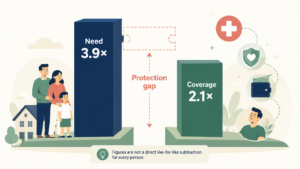
The result was an average CI protection need of S$357,864, equivalent to 3.9 times average annual income, rather than five times annual income.
This was expressed by LIA as an approximate four-times-income rule of thumb.
Interested to learn more?
Fill in the form below and we will get back to you!
Why can dependant needs extend beyond five years?
The five-year assumption applied to the modelled recovery period, but not every financial responsibility was automatically cut off after five years.
The study recognised that returning to work does not always mean returning to the same earning capacity.
A critical illness survivor may:
- Work fewer hours
- Change occupation
- Accept a lower-paying role
- Experience recurring health limitations
- Lose career progression
- Become more vulnerable to future employment disruption
Because of this, selected dependant needs were projected beyond the five-year recovery period.
Dependant children
The financial needs of children were projected until the youngest child reached age 20.
This reflected the possibility that a parent’s ability to support their children could remain affected even after returning to employment.
Interested to learn more?
Fill in the form below and we will get back to you!
Elderly parents
The needs of dependant elderly parents were projected based on the study’s assumed life expectancy.
This recognised that financial support for parents may continue for much longer than the immediate treatment period.
The five-year recovery assumption therefore does not mean all household consequences disappear at the end of year five.
What did Singaporeans expect the recovery period to be?
As part of the Protection Gap Study, a supplementary survey was conducted among economically active adults.
Respondents estimated an average critical illness recovery period of approximately 3.4 years.
This was shorter than the five-year period used in the study’s financial model.
The comparison does not prove that individuals were wrong about their own likely recovery.
It shows that public expectations were, on average, shorter than the assumption used for national modelling.
A person estimating their own needs may naturally focus on:
- Time spent receiving treatment
- Expected medical leave
- When they hope to return to work
The study took a broader approach that also considered household finances and the possibility of reduced earning ability.
Recovery and return to work are not always the same
A person may technically return to work while still experiencing financial disruption.
Consider someone who returns after cancer treatment but:
- Works only three days per week
- Cannot perform the same duties
- Stops receiving overtime pay
- Loses commission income
- Changes to a less demanding role
- Requires frequent medical appointments
- Depends more heavily on their spouse
- Continues paying for rehabilitation or caregiving
They may be considered employed again, but their household may not have returned to its previous financial position.
This is one reason critical illness planning should not focus only on the date someone is expected to resume employment.
It should also consider:
What level of income and work capacity might realistically return?
Interested to learn more?
Fill in the form below and we will get back to you!
Different occupations can experience different recovery effects
The same medical condition may have different financial consequences depending on the person’s occupation.
Office-based employee
An office worker may be able to return gradually, work remotely or move temporarily into lighter duties.
Self-employed person
A self-employed individual may have no paid medical leave and may lose customers while away from the business.
Commission-based professional
Someone whose income depends heavily on sales or performance may experience an immediate reduction even if they continue working part-time.
Manual worker
A person in a physically demanding role may be medically stable but unable to meet the physical requirements of the job.
Business owner
A business owner may face both personal income loss and additional costs from hiring someone to manage operations.
This is why a national average cannot determine the correct recovery period for every individual.
Interested to learn more?
Fill in the form below and we will get back to you!
What about paid medical leave and employer benefits?
Employer benefits can reduce the immediate effect of income disruption.
Depending on the employment arrangement, a person may have access to:
- Paid outpatient sick leave
- Paid hospitalisation leave
- Extended medical leave
- Group critical illness insurance
- Disability income benefits
- Flexible work arrangements
- Employer-funded rehabilitation
- Continued salary for a limited period
However, employer support may be:
- Temporary
- Subject to eligibility rules
- Tied to continued employment
- Reduced after a certain period
- Changed by the employer
- Insufficient for a prolonged recovery
A financial review should therefore establish:
- How long salary continues
- What proportion of income is protected
- Whether variable income is included
- Whether group benefits remain after leaving the company
- What happens after paid leave is exhausted
Employer benefits can be valuable, but they should not automatically be treated as permanent personal protection.
Interested to learn more?
Fill in the form below and we will get back to you!
Were hospital bills included in the five-year need?
The Protection Gap Study assumed that immediate hospitalisation and surgery expenses would be adequately addressed through:
- MediShield Life
- MediSave
- An Integrated Shield Plan
The study’s CI protection calculation therefore focused mainly on household expenses, debts and other financial needs during recovery.
This was a modelling assumption, not a guarantee that every medical bill would be fully reimbursed.
Actual reimbursement depends on the specific health insurance policy terms, including deductibles, co-insurance, exclusions, benefit limits, eligible treatments and other policy conditions.
Hospitalisation insurance and CI insurance address different financial risks:
- Hospitalisation insurance generally reimburses eligible medical expenses, subject to policy terms.
- Critical illness insurance generally pays a lump sum when the contractual claim definition is met.
The five-year recovery period relates mainly to the wider financial consequences of illness—not five years of hospital bills.
Interested to learn more?
Fill in the form below and we will get back to you!
Were savings included in the recovery model?
For the CI protection-gap calculation, the study counted existing individual and group CI insurance as available financial resources.
It did not deduct remaining CPF savings or other personal savings from the estimated CI need.
The study assumed that:
- MediSave would support immediate medical needs
- Remaining CPF balances were generally unavailable for day-to-day recovery expenses
- Other personal savings were still needed for retirement and later-life requirements
This is a modelling assumption.
An individual may still choose to use cash, investments or other assets during recovery.
The more relevant question is whether those assets are genuinely available without damaging another important goal.
For example:
- Would retirement plans be delayed?
- Would education savings be depleted?
- Would investments need to be sold during a market decline?
- Would the emergency fund run out before income recovers?
Savings can reduce the amount of insurance required, but only when they are intentionally allocated for that purpose.
Should you personally plan for exactly five years?
Not necessarily.
The five-year period is a useful starting point, but your own planning horizon should reflect your circumstances.
You may need a longer buffer if you have:
- Variable or commission-based income
- No paid medical leave
- A physically demanding occupation
- A business that depends heavily on you
- Young children
- Dependant elderly parents
- A large mortgage
- Limited spouse income
- Little accessible savings
- Weak employer benefits
Interested to learn more?
Fill in the form below and we will get back to you!
You may require a smaller insurance buffer if you have:
- Strong paid medical leave
- Dependable spouse income
- Few financial dependants
- Low fixed expenses
- Substantial existing CI coverage
- Liquid assets specifically reserved for illness
- Income that can continue without active work
The five-year assumption should be used to test your preparedness—not followed mechanically.
A practical way to assess your recovery needs
Begin by estimating what would happen if your earning ability were disrupted.
Step 1: Calculate essential monthly commitments
Include:
- Food and household expenses
- Utilities
- Insurance premiums
- Housing loan payments
- Personal loan payments
- Rent, where applicable
- Children’s needs
- Support for elderly parents
- Childcare and caregiving
- Necessary transport
Step 2: Estimate how income may change
Consider:
- Paid medical leave
- Employer salary support
- Spouse’s income
- Business income
- Commission loss
- Reduced working hours
- A lower-paying role
Step 3: Select a reasonable planning period
Test several scenarios rather than relying on a single number:
- One year
- Three years
- Five years
- Longer-term reduced income
Interested to learn more?
Fill in the form below and we will get back to you!
Step 4: Review available resources
Include:
- Existing personal CI insurance
- Employer CI benefits
- Accessible savings
- Other reliable income
- Assets deliberately reserved for recovery
Step 5: Identify the remaining shortfall
The result can help show whether your current protection appears sufficient, excessive or incomplete.
An illustrative recovery calculation
Assume a household requires S$5,000 per month for essential commitments.
The individual expects their spouse and employer benefits to cover S$2,000 per month during recovery.
The remaining monthly shortfall would be:
S$5,000 − S$2,000 = S$3,000
Over five years, a simple derived illustration would be:
S$3,000 × 12 × 5 = S$180,000
This is an author-created illustration, not the Protection Gap Study formula.
It also excludes possible changes in expenses, inflation, employer benefits, spouse income and existing insurance.
Its purpose is simply to show how the length of recovery can materially affect financial needs.
The danger of planning only for treatment duration
Someone may assume they need support only while receiving treatment.
But financial recovery may continue after active treatment ends.
Possible ongoing effects include:
- Reduced income
- Rehabilitation expenses
- Recurring medical appointments
- Additional domestic help
- Childcare support
- Transport costs
- Career disruption
- Business interruption
- Greater dependence on a spouse
Planning only for the hospital or treatment phase may therefore underestimate the full household impact.
Interested to learn more?
Fill in the form below and we will get back to you!
Frequently asked questions
Does LIA say every critical illness takes five years to recover from?
No. Five years is an average modelling assumption used in the Protection Gap Study. Actual recovery varies by illness, severity, treatment, occupation and individual circumstances.
Does five years mean five years without working?
No. A person may continue working, return part-time or move into a different role. The model recognises that earning ability may still be affected during and after recovery.
Why did survey respondents estimate 3.4 years?
The supplementary survey found that respondents expected an average recovery period of 3.4 years. This reflected public perception and was shorter than the five-year assumption used in the study.
Does five years mean I need five times my salary?
No. The study did not multiply annual income by five. It modelled household expenses, loans, rent, dependant needs and spouse income. The resulting average need was approximately 3.9 times annual income.
Are children’s and parents’ needs limited to five years?
Not necessarily. Selected dependant needs were projected beyond five years because reduced earning ability could continue after a person returned to work.
Should I automatically buy enough insurance to cover five years?
No. Existing insurance, employer benefits, spouse income, savings, debts and household responsibilities should all be assessed before determining any shortfall.
Interested to learn more?
Fill in the form below and we will get back to you!
Final thoughts
LIA’s five-year critical illness recovery period is not a forecast of exactly how long every person will be ill or unemployed.
It is a national modelling assumption used to estimate the broader financial impact of critical illness.
That impact can include:
- Household expenses
- Debt repayments
- Rent
- Caregiving
- Children
- Elderly parents
- Reduced income
- A gradual or incomplete return to work
The five-year period is useful because it forces the financial-planning conversation beyond hospital bills and short-term medical leave.
The more meaningful question is:
If your income and work capacity were affected for several years, how long could your household continue without exhausting the resources meant for other goals?
Estimate your critical illness recovery needs
Review how your household expenses, income, debts and dependants could be affected during a prolonged recovery.
This article is for general information only and does not constitute personalised financial advice. Insurance needs and product suitability should be assessed according to individual circumstances.