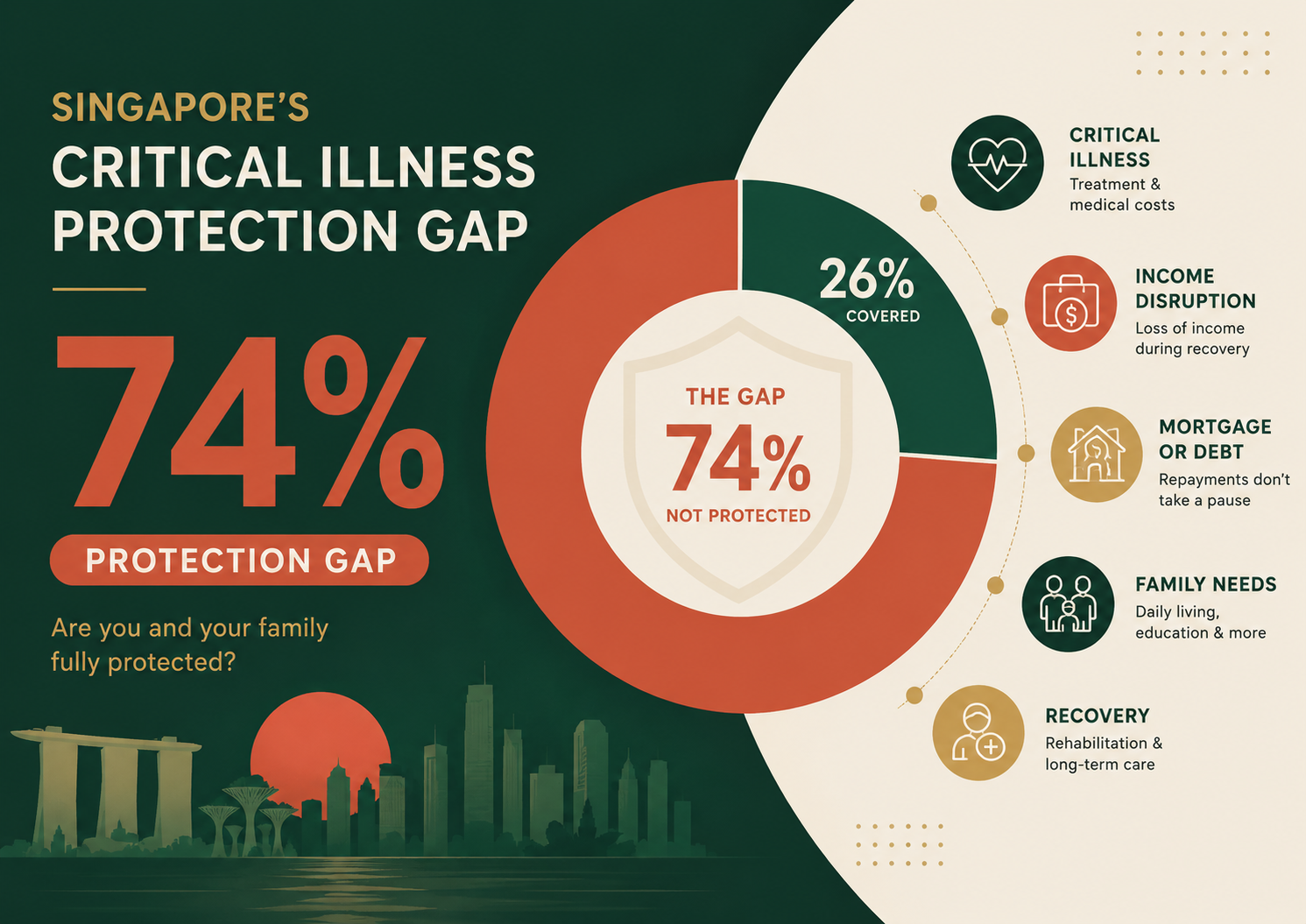
Singapore’s critical illness protection gap was estimated at 74% in the Life Insurance Association Singapore’s Protection Gap Study 2022.
The study estimated that economically active adults had:
- S$783 billion in total critical illness protection needs
- S$204 billion in existing individual and group CI insurance
- A resulting S$579 billion critical illness protection gap
These figures were based on policy data, reference data and assumptions as at 31 December 2021. The study was published in September 2023.
The 74% figure is significant, but it is also frequently misunderstood.
It does not mean that 74% of Singaporeans have no critical illness insurance. It also does not mean that every individual personally lacks exactly 74% of the coverage they need.
It is an aggregate national estimate, based on the study’s population, assumptions and methodology.
Check your own critical illness protection gap
Compare LIA’s approximately four-times-income benchmark with your existing personal and employer CI coverage.
Singapore’s critical illness protection gap at a glance
| Protection Gap Study 2022 | Estimated amount |
|---|---|
| Total CI protection needs | S$783 billion |
| Existing CI insurance | S$204 billion |
| CI protection gap | S$579 billion |
| Percentage of needs met | 26% |
| Percentage gap | 74% |
Expressed as a simple derived illustration:
For every S$100 of modelled critical illness protection need, approximately S$26 was covered by existing CI insurance, leaving S$74 as the protection gap.
This is a population-level illustration based on the study’s rounded percentages. It is not a calculation of any one person’s insurance shortfall.
What is a critical illness protection gap?
A critical illness protection gap is the difference between:
The estimated financial needs arising from a critical illness
and:
The financial resources counted as available to meet those needs
For the CI portion of the Protection Gap Study, the resources counted were existing individual and group critical illness insurance benefits.
The gap can therefore be expressed as:
CI protection needs − existing CI insurance = CI protection gap
Using the study’s aggregate figures:
S$783 billion − S$204 billion = S$579 billion
The Protection Gap Study describes the CI gap as the amount required to support family expenses and outstanding debt payments during the assumed recovery period, less existing CI insurance coverage.
Source: LIA Protection Gap Study 2022
Does a 74% gap mean 74% of Singaporeans are uninsured?
No.
A protection gap measures a difference in dollars, not simply the percentage of people who do or do not own a policy.
Consider two simplified situations:
- Someone may own a CI policy but have only a small amount of coverage relative to their estimated household needs.
- Someone else may have no personal CI policy but receive some coverage through an employer group plan.
Both situations contribute differently to the aggregate protection gap.
Check your own critical illness protection gap
Compare LIA’s approximately four-times-income benchmark with your existing personal and employer CI coverage.
The 74% figure combines the modelled protection needs and CI insurance coverage of the entire study population. It does not divide Singaporeans neatly into “insured” and “uninsured” groups.
A more accurate interpretation is:
Existing CI insurance was estimated to cover approximately 26% of the study population’s total modelled critical illness protection needs.
Who was included in the study?
The study focused on economically active Singapore citizens and Permanent Residents who were:
- Aged between 20 and 69
- Economically active
- Supporting at least one dependant
The economically active population used in the study was estimated at 2,187,833 people.
Platform workers were also examined as a separate subset for the first time. These included private-hire drivers, taxi drivers and delivery workers.
Source: LIA Protection Gap Study 2022
The findings should therefore not be applied automatically to:
- Retirees
- Economically inactive adults
- Homemakers
- Unemployed adults
- Adults without dependants
- People outside the study’s age range
These individuals may still need critical illness protection, but the four-times-income benchmark and 74% aggregate gap were not designed specifically around their circumstances.
Check your own critical illness protection gap
Compare LIA’s approximately four-times-income benchmark with your existing personal and employer CI coverage.
What financial needs were included?
The study did not treat critical illness solely as a hospital-bill problem.
It considered broader household and financial needs such as:
- Ongoing household expenditure
- Personal and housing loan payments
- Rent
- Financial needs of dependent children
- Financial support for elderly parents
- Replacement of unpaid household services
- Income available from an economically active spouse
The study used an assumed five-year critical illness recovery period when projecting many expenses.
However, the needs of children and elderly parents could extend beyond five years because the model also considered the possibility that a survivor’s future earning ability might remain reduced after returning to work.
Source: LIA Protection Gap Study 2022
This is why the CI protection need should not be read simply as:
Five years of salary replacement.
It is a broader household-needs model expressed as an aggregate financial estimate.
Check your own critical illness protection gap
Compare LIA’s approximately four-times-income benchmark with your existing personal and employer CI coverage.
Were hospital and treatment expenses included?
The Protection Gap Study assumed that immediate hospitalisation and surgery expenses would be adequately addressed through:
- MediShield Life
- MediSave
- An Integrated Shield Plan
Its critical illness protection calculation therefore focused mainly on household expenses, debts and other financial needs during recovery.
Source: LIA Protection Gap Study 2022
This is a modelling assumption, not a promise that every person’s medical expenses will be fully reimbursed.
Actual reimbursement depends on the terms of the specific health insurance policy, including:
- Deductibles
- Co-insurance
- Claim limits
- Exclusions
- Eligible treatments
- Rider provisions
- The hospital and ward used
- Other policy conditions
Hospitalisation insurance and critical illness insurance serve different purposes.
Check your own critical illness protection gap
Compare LIA’s approximately four-times-income benchmark with your existing personal and employer CI coverage.
A hospital plan generally reimburses eligible medical expenses, subject to the specific policy terms. Critical illness insurance generally pays a lump sum when the relevant contractual claim definition is met.
That cash may be used for:
- Income disruption
- Debt payments
- Household expenditure
- Caregiving
- Rehabilitation
- Other recovery needs
Why were CPF and personal savings excluded?
This is one of the most important qualifications behind the 74% figure.
For the CI protection-gap calculation, the study assumed that only CI insurance coverage was available as a resource.
CPF savings and other personal savings were not deducted from the modelled CI protection needs.
The study assumed that:
- MediSave would be used to support immediate medical needs
- Remaining CPF balances generally could not be withdrawn to fund living expenses during recovery
- Other personal savings were still needed for later-life and retirement needs
The study therefore treated CI insurance—not savings—as the available financial resource against the CI protection need.
Source: LIA Protection Gap Study 2022
This differs from the mortality protection-gap calculation, where CPF and other savings were counted as available resources.
That methodological difference is one reason the reported CI gap was much higher than the mortality gap.
Does this mean savings cannot be used during a critical illness?
No.
The study’s treatment of savings is a modelling assumption. It is not a rule preventing individuals from using their own money.
A person may choose to rely partly on:
- Cash savings
- Fixed deposits
- Investments
- Spouse’s income
- Business income
- Employer benefits
- Other liquid assets
However, using these resources may create other consequences.
Check your own critical illness protection gap
Compare LIA’s approximately four-times-income benchmark with your existing personal and employer CI coverage.
For example:
- Retirement savings may need to be rebuilt.
- Investments may have to be sold during an unfavourable market.
- Education funds may be redirected.
- A spouse may need to take unpaid leave.
- Emergency savings may be depleted early in the recovery period.
A personal CI review should therefore ask not only whether savings exist, but also:
How much of those savings are genuinely available for illness without damaging another important financial goal?
Why did the gap improve from 81% to 74%?
The Protection Gap Study found that Singapore’s CI protection gap narrowed from:
- 81% in 2017
- To 74% in 2022
Existing CI insurance grew substantially during the period.
LIA’s public FAQ attributes the improvement mainly to an approximate 63% increase in CI coverage since 2017, while the full EY report refers elsewhere to a 67% increase.
Both figures point to an increase of roughly two-thirds. To avoid treating the two source-specific figures as identical, the safest general wording is:
CI insurance coverage increased by approximately two-thirds from 2017.
The average individual CI coverage per policyholder also increased from approximately:
- S$128,900 in 2017
- To S$193,300 in 2022
That was equivalent to around 2.1 times average annual income in the 2022 study.
Source: LIA Protection Gap Study 2022 — Public FAQ
Why did the dollar gap increase even though the percentage fell?
This is one of the sharpest findings in the study.
| Study | CI needs | Existing CI insurance | CI gap | Gap percentage |
|---|---|---|---|---|
| 2017 | S$663 billion | S$125 billion | S$538 billion | 81% |
| 2022 | S$783 billion | S$204 billion | S$579 billion | 74% |
Figures are rounded as presented in the LIA study.
The percentage gap improved because CI insurance coverage grew significantly.
However, total protection needs also rose from:
- S$663 billion
- To S$783 billion
As a result:
- The percentage shortfall became smaller
- But the absolute dollar shortfall still grew from S$538 billion to S$579 billion
This means progress was made, but the growth in insurance coverage was not enough to reduce the total dollar amount left uncovered.
Source: LIA Protection Gap Study 2022 — Key Findings
Check your own critical illness protection gap
Compare LIA’s approximately four-times-income benchmark with your existing personal and employer CI coverage.
Why did total CI protection needs rise?
The study’s overall needs increased as the modelled financial responsibilities of economically active adults increased.
Factors reflected within the study’s model included:
- Household expenditure
- Debt obligations
- Income changes
- Changes in the economically active population
- Costs associated with supporting dependants
The study’s purpose was not to forecast the exact financial loss of each individual. It estimated a national average using household profiles, income levels, dependants and other assumptions.
The key takeaway is not merely that insurance coverage was low.
It is that:
The amount households may need following a major illness can rise over time, even when a person already owns CI insurance.
How does the 74% gap translate to an individual?
The study also estimated an average CI protection gap of S$264,586 per economically active adult within its model.
That figure was based on:
- Average CI protection need of S$357,864
- Less existing insurance coverage of S$93,278
- Resulting in an average gap of S$264,586
These are explicit modelled averages from the full EY report. They are not recommendations that every individual should purchase an additional S$264,586.
Source: LIA Protection Gap Study 2022
Someone’s actual gap could be:
- Higher than the average
- Lower than the average
- Fully met
- Or potentially nonexistent after considering their personal circumstances
The result depends on income, dependants, debts, spouse’s income, existing insurance and the resources the person is genuinely prepared to use.
Why owning a CI policy may not be enough
The study illustrates an important distinction:
Policy ownership and adequate coverage are not the same thing.
Someone may own CI insurance but still be underinsured because:
- The policy was purchased when their income was lower
- Their family has grown
- They have taken on a larger mortgage
- Their household expenses have increased
- Their employer coverage is limited or temporary
- Their benefits are divided across different illness stages
- Some payouts may reduce other benefits under the same policy
The LIA Critical Illness Framework 2024 standardises only the severe-stage definitions of 37 listed critical illnesses.
Early-stage, intermediate-stage, multiple-claim and other product features may vary between insurers. These must be checked against the specific policy schedule, product summary and policy contract.
Check your own critical illness protection gap
Compare LIA’s approximately four-times-income benchmark with your existing personal and employer CI coverage.
What should you do with the 74% figure?
The 74% national gap should not be used to frighten someone into purchasing insurance.
It should prompt a more practical question:
How much of my own critical illness financial need is currently covered?
A useful review involves four steps.
Step 1: Estimate your starting need
LIA’s Protection Gap Study uses approximately four times annual income as a population-level rule of thumb, based on its average demographic and five-year recovery assumption.
A simple derived calculation is:
Annual income × 4
This is a starting benchmark, not a universal recommendation.
Step 2: List your existing CI benefits
Include:
- Personal standalone CI policies
- CI riders
- Employer group benefits
- Severe-stage coverage
- Early or intermediate-stage coverage
- Multiple-claim benefits
Do not add every headline benefit together automatically. Check whether one payout reduces another and whether the benefit remains available after a claim.
Step 3: Decide what other resources you are prepared to use
Consider:
- Accessible cash
- Spouse’s income
- Investments
- Employer benefits
- Business income
- Other liquid resources
Separate money that is genuinely available from money already committed to retirement, education or other essential goals.
Step 4: Adjust for your household
Review:
- Essential monthly expenses
- Personal and housing loans
- Rent
- Children
- Elderly parents
- Income stability
- Paid medical leave
- The portability of employer benefits
The resulting figure is more useful than assuming your personal shortfall must equal the national 74% average.
Check your own critical illness protection gap
Compare LIA’s approximately four-times-income benchmark with your existing personal and employer CI coverage.
Frequently asked questions
Does a 74% CI protection gap mean only 26% of Singaporeans are insured?
No. The figures refer to the proportion of aggregate modelled financial needs met by CI insurance—not the proportion of people who own insurance.
Does the S$579 billion gap include personal savings?
No. The CI calculation counted existing CI insurance as the available resource. CPF and other personal savings were excluded under the study’s assumptions.
Why were savings counted for mortality but not for CI?
The mortality calculation assumed CPF and savings could support surviving dependants after death.
For CI, the study assumed MediSave would support immediate medical needs, remaining CPF balances were generally unavailable during recovery and other savings were needed for retirement and future lifestyle requirements.
Is the 74% gap still current?
The Protection Gap Study 2022 was published in September 2023 using data and assumptions as at 31 December 2021.
It remains the referenced LIA study used in this article, but it should not be presented as a real-time measurement of Singapore’s position today.
Does everyone need to buy four times their annual income in CI insurance?
No.
Approximately four times annual income is a population-level rule of thumb from the study. Personal needs should be assessed according to income, debts, dependants, existing insurance and other available resources.
Check your own critical illness protection gap
Compare LIA’s approximately four-times-income benchmark with your existing personal and employer CI coverage.
Should I replace an existing CI policy if it seems insufficient?
Not automatically.
Replacing an existing policy may involve:
- New underwriting
- Exclusions
- Waiting periods
- Higher premiums
- Loss of existing contractual benefits
Supplementing existing protection may sometimes be considered instead, depending on the policy and individual circumstances.
Final thoughts
Singapore’s 74% critical illness protection gap does not mean that 74% of people have no insurance.
It means that, under LIA’s national model, existing individual and group CI insurance covered approximately 26% of the total financial need created by critical illness.
The study estimated:
- S$783 billion in total protection needs
- S$204 billion in existing CI insurance
- S$579 billion left as the aggregate gap
The percentage gap improved from 81% to 74%, but the total dollar gap still increased because overall financial needs also grew.
The figure should therefore be treated as a prompt to review—not a personal prescription.
The more useful question is:
If illness disrupted your household income and expenses for several years, how much of that financial need would your current coverage actually meet?
This article is for general information only and does not constitute personalised financial advice. Insurance needs and product suitability should be
assessed according to individual circumstances.
Sources
- Life Insurance Association Singapore — Protection Gap Study 2022
- Life Insurance Association Singapore — Protection Gap Study 2022: Key Findings
- Life Insurance Association Singapore — Protection Gap Study 2022: Public FAQ
- Life Insurance Association Singapore — Official Protection Gap Study Release
- Life Insurance Association Singapore — Critical Illness Framework 2024