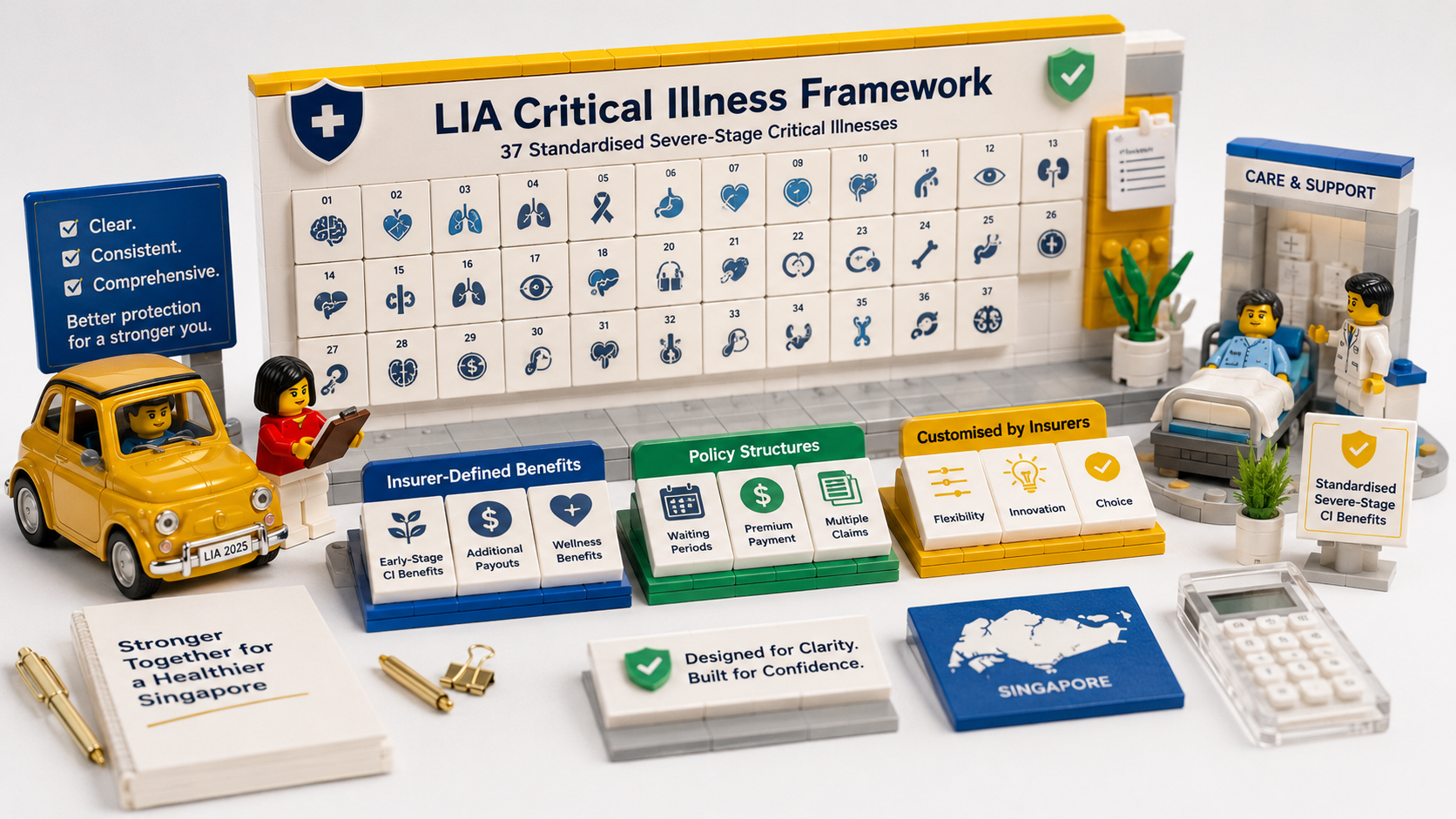

The Life Insurance Association Singapore’s Critical Illness Framework contains standard definitions for the severe stage of 37 critical illnesses.
However, the list is commonly misunderstood.
It does not mean:
- Every CI policy must cover all 37 conditions
- Every diagnosis automatically qualifies for a payout
- Early-stage conditions are standardised
- Every insurer pays the same amount
- All 37 conditions are assessed in the same way
Some definitions require a confirmed diagnosis. Others require a particular operation, permanent disability, loss of daily functioning or a stated life expectancy.
This guide explains the 37 critical illnesses in Singapore in plain English, based on the LIA Critical Illness Framework 2024.
It is an educational summary—not a replacement for the full medical definitions or your policy contract.
Interested to learn more?
Fill in the form below and we will get back to you!
What are the 37 critical illnesses in Singapore?
The 37 conditions under the LIA Framework are:
- Major Cancer
- Heart Attack of Specified Severity
- Stroke with Permanent Neurological Deficit
- Coronary Artery By-pass Surgery
- End Stage Kidney Failure
- Irreversible Aplastic Anaemia
- End Stage Lung Disease
- End Stage Liver Failure
- Coma
- Deafness (Irreversible Loss of Hearing)
- Open-Heart Heart Valve Surgery
- Irreversible Loss of Speech
- Major Burns
- Major Organ/Bone Marrow Transplantation
- Multiple Sclerosis
- Muscular Dystrophy
- Idiopathic Parkinson’s Disease
- Surgery to Aorta
- Alzheimer’s Disease / Severe Dementia
- Fulminant Hepatitis
- Motor Neurone Disease
- Primary Pulmonary Hypertension
- HIV Due to Blood Transfusion and Occupationally Acquired HIV
- Benign Brain Tumour
- Severe Encephalitis
- Severe Bacterial Meningitis
- Angioplasty & Other Invasive Treatment for Coronary Artery
- Blindness (Irreversible Loss of Sight)
- Major Head Trauma
- Paralysis (Irreversible Loss of Use of Limbs)
- Terminal Illness
- Progressive Scleroderma
- Persistent Vegetative State (Apallic Syndrome)
- Systemic Lupus Erythematosus with Lupus Nephritis
- Other Serious Coronary Artery Disease
- Poliomyelitis
- Loss of Independent Existence
These are the official Version 2024 severe-stage headers. (LIA)
Interested to learn more?
Fill in the form below and we will get back to you!
The word “critical” does not mean every medically serious case qualifies
A medical condition can be serious without satisfying the contractual severe-stage definition.
For example:
- Cancer may be diagnosed but remain within an excluded early or non-invasive classification.
- A stroke may occur without producing the required permanent neurological deficit.
- Kidney function may deteriorate significantly without requiring permanent dialysis or transplantation.
- Heart disease may be present without meeting the specified narrowing or procedural requirements.
- A person may struggle with daily activities without satisfying the required number or duration under the definition.
CI insurance pays according to the definition in the applicable contract—not simply according to the name of the diagnosis.
The 37 definitions do not all use the same type of claim trigger
The definitions generally fall into several broad types.
Diagnosis-based conditions
These require a confirmed diagnosis together with specified severity, medical evidence or lasting impairment.
Examples include:
- Major Cancer
- Multiple Sclerosis
- Alzheimer’s Disease / Severe Dementia
- Motor Neurone Disease
Interested to learn more?
Fill in the form below and we will get back to you!
Procedure-based conditions
The operation or medical procedure must actually have taken place.
Examples include:
- Coronary Artery By-pass Surgery
- Open-Heart Heart Valve Surgery
- Surgery to Aorta
- Angioplasty
Being advised to undergo a procedure may not be enough where the definition requires the procedure to have been performed.
Permanent-impairment conditions
These require a lasting loss of physical, sensory or neurological function.
Examples include:
- Stroke with Permanent Neurological Deficit
- Deafness
- Blindness
- Paralysis
- Major Head Trauma
Activities-of-Daily-Living conditions
Some definitions assess whether the insured can carry out basic daily functions.
Examples include:
- Muscular Dystrophy
- Idiopathic Parkinson’s Disease
- Loss of Independent Existence
Prognosis-based conditions
Terminal Illness requires medical evidence that, despite reasonable treatment, the insured is expected to live for no more than 12 months.
Understanding the type of trigger is often more useful than simply counting the conditions listed.
Cancer, organ failure and blood-related conditions
The following plain-English summaries are based on the full Version 2024 definitions. Exact exclusions and medical requirements remain subject to the applicable policy contract. (LIA)
| No. | Critical illness | Plain-English explanation |
|---|---|---|
| 1 | Major Cancer | An invasive malignant tumour confirmed through appropriate medical evidence. Many pre-malignant, non-invasive, carcinoma-in-situ and specified low-stage cancers are excluded from the severe-stage definition. |
| 5 | End Stage Kidney Failure | Both kidneys have irreversibly failed, requiring permanent dialysis or a kidney transplant. |
| 6 | Irreversible Aplastic Anaemia | Permanent bone-marrow failure confirmed by biopsy, causing serious shortages of blood cells and requiring specified treatments such as transfusions, immunosuppressants or transplantation. |
| 7 | End Stage Lung Disease | Severe and permanent respiratory failure supported by several medical measurements, permanent supplementary oxygen and breathlessness even at rest. |
| 8 | End Stage Liver Failure | Advanced liver failure involving permanent jaundice, fluid accumulation in the abdomen and hepatic encephalopathy. Liver disease caused by alcohol or drug abuse is excluded. |
| 14 | Major Organ/Bone Marrow Transplantation | The insured has actually received a covered human-organ transplant or qualifying bone-marrow transplant. Covered organs include the heart, lung, liver, kidney and pancreas. |
| 20 | Fulminant Hepatitis | Rapid and extensive destruction of the liver caused by a hepatitis virus, leading suddenly to liver failure and supported by the specified medical findings. |
1. Major Cancer
The severe-stage Major Cancer definition generally requires:
- A malignant tumour
- Histological confirmation
- Uncontrolled malignant-cell growth
- Invasion and destruction of normal tissue
It includes cancers such as leukaemia, lymphoma and sarcoma, but contains numerous exclusions.
Examples of excluded categories include:
- Pre-malignant tumours
- Non-invasive tumours
- Carcinoma-in-situ
- Borderline malignancies
- Certain low-stage prostate, thyroid, neuroendocrine and bladder cancers
- Early gastrointestinal stromal tumours
- Certain bone-marrow malignancies not requiring major intervention
A liquid-biopsy or bodily-fluid finding alone, without further definitive and clinically verifiable evidence, does not satisfy the Version 2024 Major Cancer definition. (LIA)
This does not mean an excluded cancer is harmless.
It means the diagnosis may fall outside the severe-stage benefit. A separate early-stage benefit may respond, depending on the specific policy contract.
Interested to learn more?
Fill in the form below and we will get back to you!
Heart and blood-vessel conditions
The heart-related definitions are especially important because they do not all cover the same event.
A heart attack, bypass operation, angioplasty and serious coronary artery disease are four different claim categories with different requirements. (LIA)
| No. | Critical illness | Plain-English explanation |
|---|---|---|
| 2 | Heart Attack of Specified Severity | Death of heart muscle caused by inadequate blood supply, supported by at least three of four specified forms of evidence. |
| 4 | Coronary Artery By-pass Surgery | The insured has undergone covered bypass surgery to correct significant narrowing or blockage of one or more coronary arteries. |
| 11 | Open-Heart Heart Valve Surgery | The insured has undergone open-heart surgery involving an incision on the heart to repair or replace an abnormal heart valve. |
| 18 | Surgery to Aorta | Major surgery through the chest or abdomen to repair or correct specified conditions affecting the thoracic or abdominal aorta. |
| 22 | Primary Pulmonary Hypertension | Severe primary pulmonary hypertension causing substantial enlargement of the right ventricle and Class IV physical impairment. |
| 27 | Angioplasty & Other Invasive Treatment for Coronary Artery | The insured has undergone balloon angioplasty or a similar catheter procedure for at least 60% narrowing of a major coronary artery. |
| 35 | Other Serious Coronary Artery Disease | Serious narrowing across three major coronary arteries, confirmed through one invasive coronary angiography procedure. |
2. Heart Attack of Specified Severity
The definition requires evidence of a new heart attack through at least three of the following four criteria:
- Typical chest pain
- New characteristic ECG changes
- Cardiac biomarkers meeting the stated threshold
- Imaging showing new heart-muscle damage or wall-motion abnormality
Angina, a heart attack of indeterminate age and biomarker increases following certain cardiac procedures are excluded. (LIA)
A person may therefore be treated for a heart-related event without automatically satisfying this particular CI definition.
4. Coronary Artery By-pass Surgery
This requires the actual undergoing of:
- Open-chest bypass surgery, or
- Minimally Invasive Direct Coronary Artery Bypass surgery
The procedure must correct narrowing or blockage using bypass grafts and be medically necessary.
Angioplasty and other catheter-based procedures do not qualify under this definition because they are covered separately. (LIA)
11. Open-Heart Heart Valve Surgery
This definition requires open-heart surgery involving an incision on the heart for direct repair or replacement of an abnormal valve.
Procedures performed only through:
- Endoscopic surgery
- Keyhole surgery
- Catheterisation
are excluded under the Version 2024 severe-stage wording. (LIA)
Interested to learn more?
Fill in the form below and we will get back to you!
18. Surgery to Aorta
This covers the actual undergoing of major surgery through the chest or abdomen to repair or correct:
- An aneurysm
- Narrowing
- Obstruction
- Dissection
The definition applies to the thoracic and abdominal aorta, not its branches.
Procedures performed only through minimally invasive or intra-arterial techniques are excluded. (LIA)
22. Primary Pulmonary Hypertension
The condition must involve:
- Substantial right-ventricular enlargement
- Confirmation through investigations including cardiac catheterisation
- Permanent physical impairment at NYHA Class IV
Class IV generally means the person cannot carry out physical activity without discomfort and may experience symptoms even at rest. (LIA)
27. Angioplasty and other invasive coronary treatment
The insured must have actually undergone balloon angioplasty or a similar intra-arterial catheter procedure.
The definition requires:
- At least 60% narrowing
- One or more specified major coronary arteries
- Angiographic evidence
- Medical necessity confirmed by a cardiologist
Diagnostic angiography alone is excluded. (LIA)
The medical definition is standardised, but the payout amount is determined by the individual product rather than fixed by the framework.
35. Other Serious Coronary Artery Disease
The definition requires narrowing of:
- At least one major coronary artery by 75% or more
- Two other major coronary arteries by 60% or more
The narrowing must be shown in a single invasive coronary angiography report performed in one sitting.
Non-invasive imaging such as CT or MRI does not meet the required confirmation standard. (LIA)
Brain and nervous-system conditions
Many neurological definitions require more than a diagnosis.
They may require:
- Permanent neurological deficit
- Impairment lasting a specified period
- Specialist confirmation
- Medical imaging
- Inability to perform daily activities
(LIA)
| No. | Critical illness | Plain-English explanation |
|---|---|---|
| 3 | Stroke with Permanent Neurological Deficit | A new stroke confirmed by imaging that causes a permanent neurological deficit confirmed at least six weeks later. |
| 9 | Coma | A coma lasting at least 96 hours, requiring life support and causing permanent neurological deficit assessed at least 30 days after onset. |
| 15 | Multiple Sclerosis | A definite diagnosis supported by investigations and multiple neurological deficits continuing for at least six months. |
| 16 | Muscular Dystrophy | Confirmed muscular dystrophy causing inability to perform at least three of six Activities of Daily Living for six continuous months. |
| 17 | Idiopathic Parkinson’s Disease | Parkinson’s disease that cannot be controlled by medication and causes inability to perform at least three of six ADLs for six months. |
| 19 | Alzheimer’s Disease / Severe Dementia | Serious and irreversible loss of cognitive function requiring continuous supervision. |
| 21 | Motor Neurone Disease | A progressive motor-neurone condition confirmed by a neurologist and resulting in permanent neurological deficit. |
| 24 | Benign Brain Tumour | A qualifying non-cancerous tumour within the skull that has been surgically removed or, if inoperable, caused permanent neurological deficit. |
| 25 | Severe Encephalitis | Severe inflammation of the brain causing permanent neurological deficit documented for at least six weeks. |
| 26 | Severe Bacterial Meningitis | Bacterial infection of the brain or spinal-cord membranes causing significant, irreversible neurological deficit lasting at least six weeks. |
| 29 | Major Head Trauma | An accidental head injury causing permanent neurological deficit, assessed no earlier than six weeks after the accident. |
| 30 | Paralysis | Total and irreversible loss of use of at least two entire limbs for at least six weeks, with no foreseeable recovery. |
| 33 | Persistent Vegetative State | Extensive destruction of the brain cortex with the brainstem intact, medically documented for at least one month. |
| 36 | Poliomyelitis | Confirmed poliovirus infection causing paralysis of limb or breathing muscles for at least three months. |
3. Stroke with Permanent Neurological Deficit
The definition requires:
- A new stroke
- Supporting brain imaging
- Permanent clinical neurological deficit
- Confirmation by a neurologist at least six weeks after the event
Transient ischaemic attacks, commonly called mini-strokes, are excluded.
Other causes of brain damage—such as accidents, infection and certain inflammatory diseases—are also excluded from this particular stroke definition. (LIA)
Interested to learn more?
Fill in the form below and we will get back to you!
9. Coma
The severe-stage definition requires all of the following:
- No response to external stimuli for at least 96 hours
- Life-support measures necessary to sustain life
- Permanent neurological deficit assessed at least 30 days after the coma began
Medically induced coma and coma arising directly from alcohol or drug abuse or self-inflicted injury are excluded. (LIA)
16. Muscular Dystrophy and 17. Idiopathic Parkinson’s Disease
Both definitions use a functional threshold involving the inability to perform at least three of six Activities of Daily Living for six continuous months.
For Idiopathic Parkinson’s Disease, the condition must also be uncontrollable with medication. (LIA)
19. Alzheimer’s Disease / Severe Dementia
The definition requires significant deterioration of mental and social functioning arising from Alzheimer’s disease or another irreversible organic disorder.
The impairment must be serious enough to require continuous supervision.
Psychiatric illness and alcohol-related brain damage are excluded from this definition. (LIA)
24. Benign Brain Tumour
“Benign” does not mean the condition automatically fails to qualify.
A covered tumour may qualify where it is:
- Located within the cranial vault
- Limited to the brain, meninges or cranial nerves
- Surgically removed, or
- Inoperable and causing permanent neurological deficit
The definition excludes several other growths and conditions, including cysts, abscesses, vascular malformations and tumours of the pituitary gland, spinal cord or skull base. (LIA)
Sensory loss, physical impairment and trauma
These definitions focus on severe and lasting loss of physical function. (LIA)
| No. | Critical illness | Plain-English explanation |
|---|---|---|
| 10 | Deafness | Total and irreversible loss of hearing in both ears, meeting the specified sound-threshold requirements. |
| 12 | Irreversible Loss of Speech | Total and irreversible loss of speech caused by injury or disease of the vocal cords, lasting continuously for 12 months. |
| 13 | Major Burns | Third-degree burns affecting at least 20% of the insured’s body surface. |
| 28 | Blindness | Permanent and irreversible loss of sight in both eyes meeting the specified visual-acuity or visual-field threshold. |
| 37 | Loss of Independent Existence | Inability to perform at least three of six Activities of Daily Living for six continuous months because of illness, disease or injury. |
10. Deafness
The definition requires total and irreversible loss of hearing in both ears.
“Total” means the quietest sound that can be heard is 80 decibels or greater across all frequencies.
“Irreversible” means hearing cannot reasonably be restored to 40 decibels or better through medical treatment, hearing aids or surgery after the stated six-month intervention period. (LIA)
12. Irreversible Loss of Speech
The loss of speech must:
- Be total and irreversible
- Result from injury or disease affecting the vocal cords
- Continue for 12 months
- Be supported by an ENT specialist
Psychiatric causes are excluded. (LIA)
13. Major Burns
The definition requires third-degree, full-thickness burns covering at least 20% of the body’s surface. (LIA)
A painful or medically serious burn affecting a smaller area may therefore not satisfy this severe-stage definition.
28. Blindness
The definition requires permanent and irreversible loss of sight in both eyes.
Even with visual aids, vision must generally be:
- 6/60 or worse in both eyes, or
- Restricted to a visual field of 20 degrees or less in both eyes
The blindness must not be correctable through surgery, implants or other means. (LIA)
Autoimmune, infectious and other severe conditions
(LIA)
| No. | Critical illness | Plain-English explanation |
|---|---|---|
| 23 | HIV Due to Blood Transfusion and Occupationally Acquired HIV | HIV acquired through a qualifying medically necessary blood transfusion or specified occupational accident, subject to strict evidence and eligibility conditions. |
| 31 | Terminal Illness | An illness or injury where, despite reasonable medical treatment, the insured is expected to live no more than 12 months. |
| 32 | Progressive Scleroderma | Systemic progressive scleroderma affecting the skin, blood vessels and internal organs, with involvement of the heart, lungs or kidneys. |
| 34 | Systemic Lupus Erythematosus with Lupus Nephritis | Confirmed systemic lupus involving the kidneys at Class III to Class VI lupus nephritis, established through renal biopsy. |
23. HIV due to transfusion or occupational exposure
This does not provide general cover for every HIV infection.
The definition applies to tightly specified circumstances.
For blood-transfusion HIV, requirements include:
- A medically necessary transfusion
- Transfusion in Singapore after the relevant policy date
- Proof that the infection came from the institution supplying the blood
Occupational HIV applies only to listed healthcare-related occupations and requires strict evidence, including documented exposure, an early negative test and seroconversion within the stated period.
HIV acquired through other means is excluded. (LIA)
Interested to learn more?
Fill in the form below and we will get back to you!
31. Terminal Illness
The condition may arise from illness or injury.
At the time of claim, the insured must be expected to live no more than 12 months, despite all reasonable medical treatment.
The treating specialist must provide supporting medical evidence and prognosis. The insurer may also obtain an independent specialist’s assessment. (LIA)
32. Progressive Scleroderma
The definition requires a systemic disease causing progressive fibrosis in the:
- Skin
- Blood vessels
- Internal organs
It must have reached a level involving the heart, lungs or kidneys.
Localised forms and several related conditions are excluded. (LIA)
34. Systemic Lupus Erythematosus with Lupus Nephritis
A diagnosis of lupus alone is not sufficient.
The definition is restricted to lupus involving the kidneys at:
- Class III
- Class IV
- Class V
- Class VI
The lupus nephritis must be established by renal biopsy and confirmed by an appropriate specialist. (LIA)
What are the six Activities of Daily Living?
Several severe-stage definitions refer to the insured’s ability to perform the six Activities of Daily Living, or ADLs.
They are:
- Washing — bathing, showering or washing by other means
- Dressing — putting on and removing clothing and relevant appliances
- Transferring — moving between a bed and chair or wheelchair
- Mobility — moving indoors between rooms on a level surface
- Toileting — using the toilet and managing bowel and bladder functions
- Feeding — feeding oneself once food has been prepared
Under the framework, “aided” generally refers to using equipment, a device or apparatus—not receiving physical help from another person. (LIA)
An ADL-based definition may therefore require the insured to be unable to perform the activity even when using suitable equipment.
Interested to learn more?
Fill in the form below and we will get back to you!
What does “permanent neurological deficit” mean?
The framework defines “permanent” as being expected to last throughout the insured person’s lifetime.
A permanent neurological deficit refers to nervous-system dysfunction that:
- Is present during clinical examination
- Is expected to last throughout the insured’s lifetime
Possible symptoms include:
- Numbness
- Paralysis
- Localised weakness
- Difficulty speaking
- Difficulty swallowing
- Visual impairment
- Difficulty walking
- Poor coordination
- Tremor
- Seizures
- Dementia
- Delirium
- Coma
The symptom must still arise within the requirements of the particular CI definition being claimed. (LIA)
Do all critical illness plans cover all 37 conditions?
No.
The LIA framework permits insurers to cover:
- All 37 conditions
- A smaller selection
- One condition only
- The standard conditions plus additional insurer-defined illnesses
When an insurer covers one of the listed conditions at the severe stage and the framework applies, it must generally use the LIA definition.
The insurer is still free to decide:
- Which conditions to include
- How much to pay
- How long coverage lasts
- Whether the plan is single-claim or multiple-claim
- What early or intermediate stages are covered
- The premium charged
Interested to learn more?
Fill in the form below and we will get back to you!
This is why a consumer should not assume that “LIA 37 conditions” describes the entire policy.
Are early-stage critical illnesses part of the 37?
The LIA framework standardises only the severe stage of the 37 listed conditions.
It does not standardise:
- Early-stage definitions
- Intermediate-stage definitions
- Extremely severe-stage definitions
- Additional illnesses outside the list
- Multiple-claim structures
- Recurrence benefits
Insurers use their own definitions for those benefits.
Two policies may therefore use the same severe-stage LIA definitions but provide very different early-stage protection.
Do the 37 conditions account for most claims?
The conditions are not equally common in claims experience.
LIA’s industry FAQ cites Gen Re research covering 2015 to 2019, which found that five illness groups accounted for close to 90% of severe-stage claims received by insurers:
- Major Cancer
- Heart Attack of Specified Severity
- Stroke
- Other heart diseases
- Kidney failure
(LIA)
This does not make the other conditions unimportant.
It does mean that comparing policies only by the total number of conditions may distract from:
- The amount of cover
- The major claim categories
- Early-stage benefits
- Duration of protection
- How benefits interact
- Whether the premium is sustainable
Interested to learn more?
Fill in the form below and we will get back to you!
Which definition version applies to your policy?
This article uses Version 2024.
New products launched from 1 October 2025 must use the Version 2024 definitions, subject to LIA’s transition rules.
However, existing policies were not automatically updated.
A policy issued earlier may still use:
- Version 2019
- Version 2014
- An even earlier contractual definition set
Claims are assessed under the definitions and terms in the applicable policy contract.
A newer definition should not automatically be assumed to be more favourable in every situation. (LIA)
Can one insurer pay while another rejects the same condition?
Yes, this remains possible.
Even where two insurers use the same standard definition, they may receive different:
- Medical reports
- Test results
- Specialist opinions
- Dates and supporting evidence
- Policy information
The policies may also use different framework versions.
LIA states that payment by one insurer does not automatically compel another insurer to pay. However, using the same definition should generally support more consistent outcomes where the relevant facts are the same. (LIA)
Interested to learn more?
Fill in the form below and we will get back to you!
How to check whether your own policy covers the 37 conditions
Review the following documents:
- Policy schedule
- Product summary
- Critical illness rider
- Supplementary benefit document
- Definitions booklet
- Endorsements and top-up documents
- Group insurance benefit schedule
Look for:
- The conditions included
- The definition version
- Severe-stage sum assured
- Early and intermediate-stage benefits
- Whether one payout reduces another
- Single or multiple-claim limits
- Waiting and survival periods
- Coverage expiry age
- Employer-plan portability
- Major exclusions and claim requirements
Do not rely only on the marketing brochure or the number “37”.
The actual policy wording governs the benefit.
Interested to learn more?
Fill in the form below and we will get back to you!
Common misunderstandings about the 37 critical illnesses
“I was diagnosed with one of the 37, so my claim must be paid.”
Not automatically.
The diagnosis must satisfy the applicable severe-stage definition and other policy conditions.
“Every policy covers the same 37 illnesses.”
No.
Insurers may choose which conditions to include.
“The 37 include early-stage illnesses.”
The LIA list standardises the severe stage only.
“More than 37 conditions means the policy is automatically better.”
Not necessarily.
Additional conditions may be useful, but their definitions, payouts and practical relevance must be reviewed.
“The LIA framework controls the payout amount.”
No.
The framework primarily standardises severe-stage medical definitions. Product benefits and payment structures can differ.
“My old policy has been updated to Version 2024.”
No automatic update applies to existing contracts.
“A condition called permanent only needs to last for a few months.”
A persistence period may be used before permanence is assessed, but “permanent” generally means expected to last for the insured’s lifetime.
Interested to learn more?
Fill in the form below and we will get back to you!
Frequently asked questions
Why are there exactly 37 critical illnesses?
The LIA framework contains standard definitions for the severe stage of 37 commonly recognised critical illnesses.
Insurers may cover fewer, all 37 or additional conditions.
Are cancer, heart attack and stroke included?
Yes.
They are listed as Major Cancer, Heart Attack of Specified Severity and Stroke with Permanent Neurological Deficit.
Is early-stage cancer one of the 37 standard conditions?
No.
Major Cancer is the standardised severe-stage definition. Early-stage cancer benefits depend on the specific insurer and policy contract.
Is angioplasty considered a critical illness?
Angioplasty and other invasive coronary treatment appears in the list as a covered procedure with its own definition.
The insurer determines the applicable payout amount and benefit structure.
Does blindness in one eye qualify?
The LIA severe-stage Blindness definition requires permanent and irreversible loss of sight in both eyes at the stated threshold.
A separate insurer-defined benefit may apply to less extensive loss, depending on the policy.
Interested to learn more?
Fill in the form below and we will get back to you!
Does partial deafness qualify?
The severe-stage definition requires total and irreversible loss of hearing in both ears at the specified threshold.
Does being unable to work qualify as Loss of Independent Existence?
Not by itself.
The definition assesses the inability to perform at least three of six Activities of Daily Living continuously for six months.
Should I replace an older policy because it uses an earlier definition version?
Not automatically.
Replacement may involve new medical underwriting, exclusions, waiting periods, higher premiums and loss of existing contractual benefits.
The full policy should be reviewed before any replacement or cancellation decision.
Interested to learn more?
Fill in the form below and we will get back to you!
Final thoughts
The 37 critical illnesses in Singapore are not simply a list of diagnoses.
They are 37 specific severe-stage insurance definitions.
Some require:
- Invasive disease
- Permanent impairment
- A specified medical procedure
- Specialist confirmation
- Symptoms lasting for a defined period
- Loss of daily functioning
- A stated life expectancy
The LIA framework creates a common severe-stage foundation, but it does not make every CI policy identical.
Your actual protection still depends on:
- Which conditions your plan covers
- The definition version
- Your sum assured
- Early-stage benefits
- Whether payouts overlap
- How long the plan lasts
- What remains after a claim
The most important question is therefore not:
Does my policy mention the 37 critical illnesses?
It is:
Which illnesses and stages does my policy actually cover—and how much usable money would remain available under a real claim?
Your policy may list 37 conditions—but that does not reveal how protected you really are
Many policyholders recognise the familiar cancer, heart attack and stroke labels but have never checked the severity thresholds, exclusions, payout interactions or definition version governing their cover.
A detailed review can show whether your benefits apply only at the severe stage, whether earlier claims reduce later payouts and whether the coverage you bought years ago would provide enough support today.
This article is for general information only and does not constitute personalised financial advice. Claim eligibility and benefits depend on the applicable policy contract, medical evidence and individual circumstances.