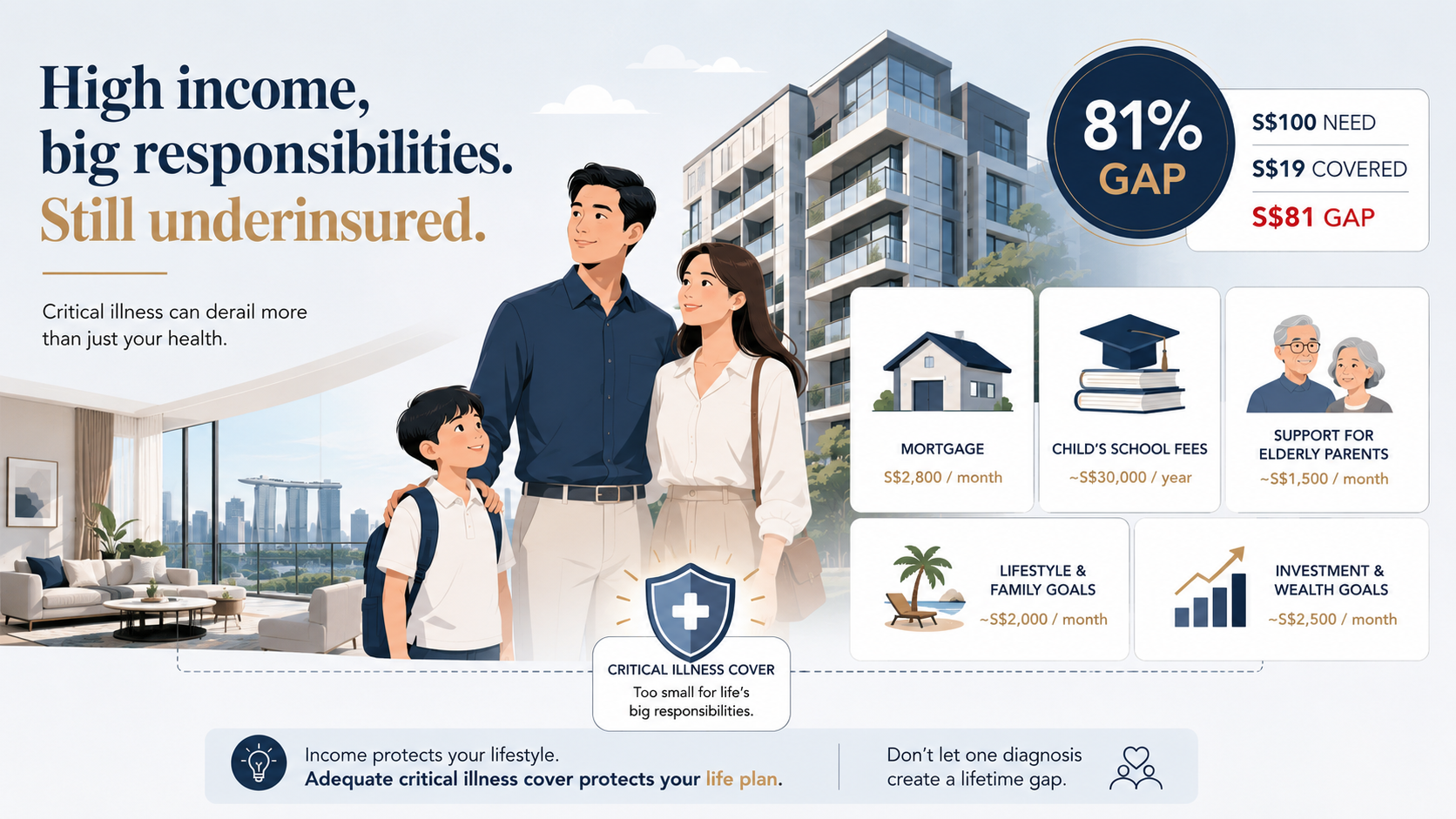

Higher income does not automatically mean adequate critical illness coverage.
The Life Insurance Association Singapore’s Protection Gap Study 2022 found a critical illness protection gap across every income quintile examined.
Among economically active adults earning at least S$8,000 per month, the modelled CI protection gap was still 81%.
This was lower than the gaps among lower-income groups, but it remained substantial.
| Monthly income quintile | Modelled CI protection gap |
|---|---|
| Below S$2,000 | 98% |
| S$2,000 to S$2,999 | 95% |
| S$3,000 to S$4,999 | 93% |
| S$5,000 to S$7,999 | 90% |
| S$8,000 and above | 81% |
The income bands and results came from the study’s segmentation of economically active Singapore citizens and Permanent Residents aged 20 to 69 with at least one dependant. The study used data and assumptions as at 31 December 2021.
These percentages are modelled averages for each income segment. They do not mean every higher-income person personally lacks exactly 81% of the coverage they need.
Interested to learn more?
Fill in the form below and we will get back to you!
However, the findings challenge a common assumption:
Earning more, saving more and owning several policies do not necessarily mean your CI protection has kept pace with your financial responsibilities.
What does an 81% CI protection gap mean?
A critical illness protection gap is the difference between:
The modelled financial need arising during critical illness recovery
and:
The CI insurance counted as available to meet that need
For the highest income quintile, the study estimated an average gap equal to 81% of that segment’s modelled CI protection needs.
Expressed as a simple derived illustration using the rounded percentage:
For every S$100 of modelled CI financial need, approximately S$19 was met by existing CI insurance, leaving S$81 as the gap.
This is a derived population-level illustration. It is not a calculation of any particular higher-income household’s shortfall.
Why the highest-income group still had a large CI gap
The study found that CI protection gaps became smaller as income increased.
This is understandable. Higher-income individuals may generally have greater financial capacity to purchase insurance.
But the gap did not disappear.
Even in the highest income quintile, existing CI insurance remained materially below the financial need estimated by the study.
The study did not assign one single explanation to every higher-income household. However, several factors can help explain why someone with a strong income may still be underinsured.
Interested to learn more?
Fill in the form below and we will get back to you!
1. Higher income can come with higher financial commitments
A person earning S$12,000 or S$20,000 per month may have greater financial capacity than someone earning S$4,000.
But they may also have:
- A larger mortgage
- Higher household expenditure
- Several children
- Private education commitments
- Elderly parents to support
- Domestic-help or caregiving costs
- Business liabilities
- A lifestyle largely funded by their active income
- A spouse or family members who rely heavily on them
The Protection Gap Study did not estimate CI needs using income alone.
Interested to learn more?
Fill in the form below and we will get back to you!
Its model included needs such as:
- Future household expenditure
- Personal and housing loans
- Rent
- Financial support for children
- Support for elderly parents
- Replacement of unpaid household services
- Income available from an economically active spouse
Higher income may therefore increase both the household’s resources and the amount required to maintain its commitments.
2. Existing CI coverage may not rise together with income
Critical illness policies are often purchased earlier in a person’s career.
The sum assured may remain unchanged even as the person’s income increases substantially.
Consider an author-created illustration.
A person purchases S$200,000 of CI coverage while earning S$60,000 per year.
At that point, the coverage represents:
S$200,000 ÷ S$60,000 = approximately 3.3 times annual income
Ten years later, the person earns S$150,000 per year, but the CI coverage remains S$200,000.
It now represents:
S$200,000 ÷ S$150,000 = approximately 1.3 times annual income
These are derived illustrative calculations, not LIA figures.
Nothing has necessarily gone wrong with the policy.
The problem is that the person’s income and commitments may have grown while the sum assured remained fixed.
Interested to learn more?
Fill in the form below and we will get back to you!
3. A higher salary creates a larger income-replacement need
A prolonged illness may affect more than basic survival expenses.
For a higher-income household, lost earnings may also affect:
- Mortgage repayments
- Investments intended for retirement
- Children’s education funding
- Support for parents
- Business capital
- Long-term financial plans
- The spouse’s ability to continue working
- The household’s capacity to maintain essential commitments
LIA’s study used a five-year CI recovery assumption when estimating many expenditure components.
This does not mean every person will stop working for five years.
A critical illness survivor may:
- Continue working during treatment
- Stop temporarily
- Return on reduced hours
- Lose variable or commission income
- Move into a less demanding role
- Experience permanently reduced earning capacity
For a high earner, even a partial reduction in income can create a substantial absolute shortfall.
Interested to learn more?
Fill in the form below and we will get back to you!
4. Employer benefits may look larger than they really are
Higher-income employees may have employer-provided group insurance.
This can be valuable, but it should not be assumed to provide complete or permanent protection.
The employee should establish:
- The CI benefit amount
- Whether it is a fixed sum or linked to salary
- Which illness stages are covered
- Whether it remains available during extended leave
- Whether it ends after resignation or retrenchment
- Whether the employer can change the group arrangement
- Whether the benefit is portable to a new employer
A person may appear well covered while employed but lose part of that protection after changing jobs.
Employer benefits should therefore be reviewed separately from personally owned policies.
Interested to learn more?
Fill in the form below and we will get back to you!
5. Owning several policies does not prove the total is sufficient
Higher-income individuals may own multiple insurance policies.
However, a longer policy list does not necessarily mean a higher usable CI payout.
The portfolio may include:
- Death coverage without CI benefits
- Hospitalisation insurance
- Personal accident insurance
- Whole-life plans with modest CI riders
- Employer insurance
- Early-stage CI benefits
- Severe-stage CI benefits
- Benefits that overlap or reduce one another
The total premiums paid also do not reveal the total CI benefit available.
The more useful review is:
How much cash would actually be paid under a qualifying early-stage or severe-stage CI claim?
Interested to learn more?
Fill in the form below and we will get back to you!
The LIA Critical Illness Framework 2024 standardises only the severe-stage definitions of 37 listed critical illnesses.
It does not standardise product features such as:
- Early-stage definitions
- Intermediate-stage definitions
- Multiple-claim structures
- Benefit amounts
- Coverage duration
- Premiums
- Waiting or survival periods
- Accelerated or additional payouts
These depend on the specific policy contract.
6. Hospitalisation insurance does not replace lost income
Someone with a comprehensive Integrated Shield Plan may reasonably feel well protected against serious illness.
However, hospitalisation and CI insurance address different financial risks.
A hospital plan generally reimburses eligible medical expenses, subject to the policy terms.
CI insurance generally pays a lump sum when the contractual claim definition is met.
The Protection Gap Study 2022 assumed that immediate hospitalisation and surgery expenses would be adequately addressed through MediShield Life, MediSave and/or an Integrated Shield Plan.
Its CI calculation therefore focused mainly on wider financial needs during recovery, including household expenditure and debt payments.
This was a modelling assumption, not a guarantee that every medical expense would be fully reimbursed. Actual reimbursement depends on the specific health insurance policy terms.
Interested to learn more?
Fill in the form below and we will get back to you!
7. Savings may be substantial but already committed elsewhere
Higher-income individuals may hold more savings and investments.
Those assets can form part of a personal recovery plan.
However, the relevant question is not simply:
How much wealth do I have?
It is:
How much of that wealth am I genuinely prepared to use during illness?
Assets may already be intended for:
- Retirement
- Children’s education
- A future property purchase
- Business expansion
- Emergency reserves
- Support for parents
- Long-term investment goals
Using those resources during a critical illness may cause another financial goal to be delayed or abandoned.
For the national CI protection-gap calculation, the study did not count CPF and other personal savings as resources available to cover CI recovery needs.
It assumed that MediSave would support immediate medical needs, while remaining CPF and other savings were preserved for retirement and later-life requirements.
This is a study assumption, not a rule preventing individuals from using their own assets.
Interested to learn more?
Fill in the form below and we will get back to you!
The contrast with the mortality gap is striking
The highest income quintile had a modelled:
- 81% CI protection gap
- Negative 7% mortality protection gap
A negative mortality gap in the model means the resources counted for that segment exceeded its modelled mortality protection needs on average.
This does not mean every higher-income household had excessive life insurance or no mortality risk.
It shows how differently the two gaps were calculated.
For mortality, the study counted:
- Life insurance
- CPF savings
- Other savings, including cash and deposits
For CI, the study counted:
- Individual CI insurance
- Group CI insurance
CPF and personal savings were excluded from the CI resources.
A higher-income household could therefore appear financially well prepared for death under the mortality model while still showing a large CI gap.
Interested to learn more?
Fill in the form below and we will get back to you!
Why death protection and CI protection can become unbalanced
Life insurance is often purchased to address large visible liabilities such as:
- A mortgage
- Children’s needs
- Support for dependants
- Estate and legacy objectives
CI protection may receive less attention because the financial consequences are less straightforward.
The person survives, but may face:
- Reduced earnings
- A long recovery
- Continued household expenses
- Debt repayments
- Caregiving costs
- A spouse reducing work
- Reduced ability to fund future goals
A household can therefore have substantial death coverage but insufficient liquidity if the main breadwinner survives a serious illness and cannot work normally.
Interested to learn more?
Fill in the form below and we will get back to you!
Does the four-times-income benchmark apply to high earners?
LIA communicated the study’s average CI need as approximately four times annual income.
The underlying study estimate was:
- Average annual income: S$90,855
- Average CI protection need: S$357,864
- Protection need multiple: 3.9 times annual income
However, LIA also stated that protection needs vary according to individual circumstances, including income levels and the number of dependants.
The four-times-income figure is therefore a broad starting point, not a rule that will fit every higher-income household.
Interested to learn more?
Fill in the form below and we will get back to you!
As income rises, someone should not automatically assume that:
- Four times income is always necessary
- Four times income is always enough
- The full amount must be purchased as new insurance
- Savings should never be considered
- Every dollar must be severe-stage CI coverage
The benchmark begins the review. It does not complete it.
Derived coverage examples for higher incomes
Using the approximate four-times-income rule of thumb as a derived screening calculation:
| Monthly income | Annual income | Derived four-times-income benchmark |
|---|---|---|
| S$8,000 | S$96,000 | S$384,000 |
| S$10,000 | S$120,000 | S$480,000 |
| S$12,000 | S$144,000 | S$576,000 |
| S$15,000 | S$180,000 | S$720,000 |
| S$20,000 | S$240,000 | S$960,000 |
These are author-derived illustrations based on LIA’s approximate rule of thumb.
They are not personalised recommendations or exact amounts prescribed by LIA.
Existing personal insurance, employer benefits and other genuinely available resources should be reviewed before estimating any shortfall.
Interested to learn more?
Fill in the form below and we will get back to you!
A higher-income household example
Consider someone earning S$15,000 per month, or S$180,000 annually.
Their derived starting benchmark would be:
S$180,000 × 4 = S$720,000
Assume they currently have:
- S$250,000 of personal severe-stage CI coverage
- S$100,000 of employer CI coverage
Their initial derived gap would be:
S$720,000 − S$250,000 − S$100,000 = S$370,000
This does not automatically mean they should purchase another S$370,000.
They should first consider:
- Whether the employer cover is portable
- Whether the personal benefit is accelerated or additional
- Whether any benefits overlap
- Whether spouse income can continue
- How much of their investments are available
- Their mortgage and other debt repayments
- The needs of children and parents
- Their actual essential household expenditure
- Whether four times income is appropriate for their household
This is an author-created illustration, not an LIA calculation or recommendation.
Interested to learn more?
Fill in the form below and we will get back to you!
Why percentage gaps can be misleading for high earners
A lower percentage gap does not necessarily mean a small dollar shortfall.
Suppose two hypothetical households have:
- Household A: S$200,000 of modelled need and a 90% gap
- Household B: S$800,000 of modelled need and an 80% gap
Their derived dollar gaps would be:
- Household A: S$180,000
- Household B: S$640,000
Household B has a lower percentage gap but a much larger dollar shortfall.
These are author-created examples.
They illustrate why higher-income households should not dismiss an 81% gap simply because it is lower than the percentages reported for other income groups.
Interested to learn more?
Fill in the form below and we will get back to you!
A practical CI review for higher-income earners
Step 1: Calculate the derived starting benchmark
Annual income × 4
Treat this as an initial screening estimate derived from LIA’s approximate rule of thumb.
Step 2: Review your actual household expenditure
Separate:
- Essential commitments
- Discretionary lifestyle spending
- Expenses that would continue during illness
- Expenses that could realistically be reduced
A person may not need to maintain every current expense during recovery, but major obligations rarely disappear immediately.
Step 3: Review debts and dependants
Include:
- Mortgage repayments
- Personal or business loans
- Children’s needs
- Support for elderly parents
- Childcare
- Caregiving
- Domestic assistance
Avoid counting both mortgage payments and rent unless both genuinely apply.
Interested to learn more?
Fill in the form below and we will get back to you!
Step 4: Identify usable CI insurance
Review:
- Personal severe-stage CI coverage
- Early or intermediate-stage benefits
- Employer CI benefits
- Whether benefits overlap
- Whether one payout reduces another
- Coverage expiry ages
Product mechanics must be checked against the specific policy contracts.
Step 5: Decide which assets are genuinely available
Identify how much cash or investments you are prepared to use without undermining:
- Retirement
- Education funding
- Emergency reserves
- Business continuity
- Other important goals
Step 6: Stress-test reduced income
Consider what happens if you:
- Stop working for one year
- Work at half capacity for three years
- Lose bonuses or commissions
- Change to a lower-paying position
- Require a spouse to reduce work
A higher-income earner may not lose their full salary, but even partial disruption can materially affect the household.
When higher-income earners should review their CI coverage
A review may be particularly useful after:
- A major salary increase
- Promotion into a more demanding role
- Starting a business
- Moving into commission-based income
- Buying or upgrading a property
- Having a child
- Taking responsibility for parents
- Changing employers
- Losing or reducing group benefits
- A significant increase in household expenses
- Several years without reviewing older policies
The purpose is not to replace existing coverage automatically.
It is to determine whether the current sum assured and policy structure still match the household’s financial position.
Interested to learn more?
Fill in the form below and we will get back to you!
Should an older CI policy be replaced?
Not automatically.
An older policy may still contain valuable contractual benefits.
Replacing it may involve:
- New medical underwriting
- Exclusions
- Higher premiums
- New waiting periods
- Loss of existing benefits
- Different claim definitions
Depending on the circumstances, retaining and supplementing existing coverage may be considered instead.
Frequently asked questions
Are all people earning above S$8,000 underinsured by 81%?
No.
The 81% figure is a modelled average for the study’s highest income quintile. Individual circumstances may differ substantially.
Interested to learn more?
Fill in the form below and we will get back to you!
Why is the Q5 threshold only S$8,000 per month?
The quintiles were defined for the study’s segmentation using data as at 31 December 2021.
They should not be interpreted as a permanent or current definition of a “high-income earner” in Singapore.
Does an 81% gap mean only 19% of high earners own CI insurance?
No.
The gap measures the proportion of modelled CI financial needs not met by CI insurance. It does not measure the percentage of people who own a policy.
Can investments replace CI insurance?
Investments can form part of a recovery plan, but their value and accessibility may vary.
The person should consider whether the investments may need to be sold during an unfavourable market and whether using them would damage another financial goal.
Should employer CI insurance be counted?
It may be included when reviewing the current position, but its amount, policy terms and portability should first be verified.
Interested to learn more?
Fill in the form below and we will get back to you!
Do higher-income earners always need four times annual income?
No.
Four times income is a population-level rule of thumb. The appropriate amount may be higher or lower after accounting for debts, dependants, spouse income, existing insurance and available assets.
Final thoughts
Higher income can improve a person’s ability to save and purchase insurance.
But it can also bring larger financial commitments and a greater dependence on continued earning power.
LIA’s Protection Gap Study found that the CI protection gap remained high across every income quintile, including an 81% modelled gap among economically active adults earning at least S$8,000 per month.
The lesson is not that every higher-income person is severely underinsured.
It is that income alone is a poor measure of preparedness.
A meaningful CI review should examine:
- How much financial need would continue during recovery
- How much usable CI insurance is actually available
- Whether employer benefits will remain
- Which assets are genuinely available
- How debts and dependants would be supported
- Whether older coverage has kept pace with income
Has your CI coverage kept pace with your income?
Your salary may have increased significantly since your policies were first purchased, while the sums assured remained unchanged.
Review your current CI benefits against your income, debts and family commitments to identify whether a shortfall has developed.
This article is for general information only and does not constitute personalised financial advice. Insurance needs and product suitability should be assessed according to individual circumstances.