

A critical illness claim is not approved simply because a doctor confirms that the policyholder is seriously ill.
For a claim to be paid, the medical condition or procedure must satisfy the specific definition and conditions stated in the applicable policy contract.
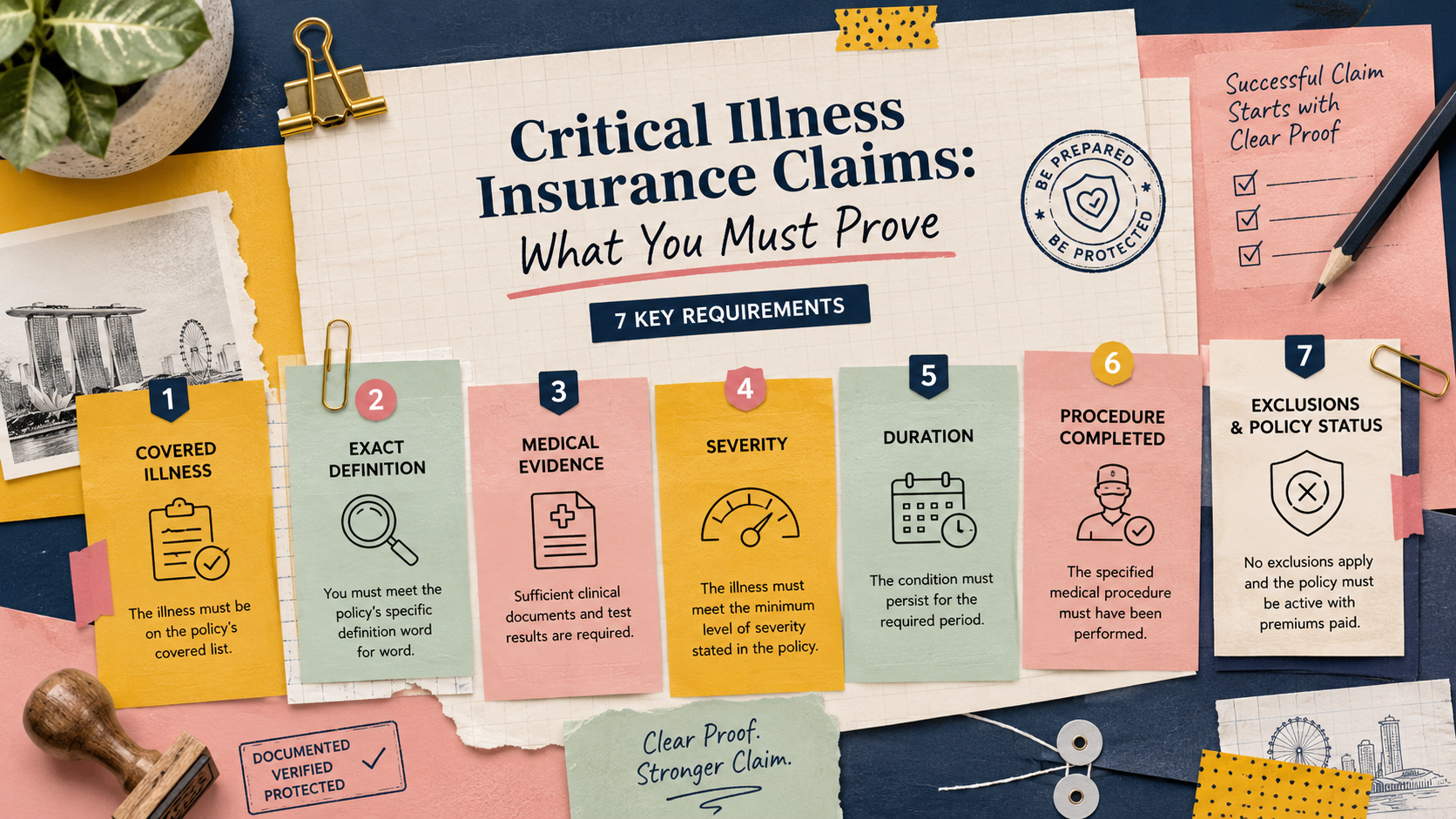
In practice, the claim documents generally need to establish that:
- The illness or procedure is covered
- The required stage or severity has been reached
- The diagnosis is supported by the specified medical evidence
- Any required procedure has actually been performed
- Waiting, persistence or survival requirements have been met
- No relevant exclusion or special policy term applies
- The policy and benefit were in force when the insured event occurred
MoneySense states that critical illness benefits are payable only when the illness or surgery meets the definition in the policy. It also notes that waiting periods may apply to specified illnesses or procedures. (MoneySense)
What does “proving a critical illness claim” mean?
A CI claim is a contractual assessment.
The insurer compares the policyholder’s medical evidence against the wording governing that particular policy.
The insurer is not deciding only whether the person is medically unwell. It is deciding whether the insured event falls within the precise protection that was purchased.
The claimant may therefore need to establish:
- The correct diagnosis
- The required severity
- The necessary medical evidence
- The required duration or permanence
- The actual completion of a covered procedure
- Compliance with the policy’s other terms
Different illnesses require different forms of proof.
The seven main requirements behind a CI claim
1. The illness or procedure must be covered
The first question is whether the diagnosed condition or completed procedure appears within the policy’s coverage.
A severe-stage CI plan may cover conditions such as:
- Major Cancer
- Heart Attack of Specified Severity
- Stroke with Permanent Neurological Deficit
- Coronary Artery By-pass Surgery
- End Stage Kidney Failure
However, insurers may cover different numbers and types of conditions. Early-stage, intermediate-stage and additional illness benefits can also vary between products. (MoneySense)
A serious condition may therefore fail to qualify because:
- It is not listed
- The policy covers only a later stage
- It is covered under another benefit that the policyholder did not purchase
- The diagnosed condition falls within an exclusion
2. The condition must meet the policy’s exact definition
The medical name alone is not enough.
A policy may not simply cover “heart attack” or “stroke”. It may cover:
- Heart Attack of Specified Severity
- Stroke with Permanent Neurological Deficit
Those additional words are part of the claim requirements.
For applicable severe-stage claims, the LIA CI Framework provides standard definitions for 37 listed critical illnesses. Earlier-stage definitions and other product-specific benefits remain insurer-defined. (Lia)
The claimant should therefore obtain the definition from the policy contract—not rely only on:
- The benefit name
- A brochure
- A general online explanation
- Another person’s policy
- The latest LIA definition
3. The required medical evidence must be provided
Most CI definitions state what medical evidence is needed.
This may include:
- Histology or biopsy results
- Blood tests
- Imaging
- Angiography
- Electrocardiograms
- Specialist reports
- Hospital records
- Surgical reports
- Evidence of functional impairment
- Evidence that a condition has persisted for a specified period
The insurer may ask the treating doctor to complete a claim form addressing the relevant definition.
Providing a diagnosis letter that does not address the contractual criteria may delay the claim or leave important requirements unproven.
4. The required severity must be reached
Severe-stage CI insurance does not necessarily pay at the earliest point when a disease is discovered.
The policy may require evidence that:
- The disease has reached a specified stage
- Permanent damage has occurred
- A stated percentage of function has been lost
- The insured cannot perform specified daily activities
- A particular treatment has become medically necessary
- A minimum level of narrowing, impairment or organ failure is present
A diagnosis can be medically significant while remaining outside the severe-stage definition.
That does not mean the illness is unimportant. It means the policy covers a narrower contractual event.
5. Any required duration must be completed
Some definitions cannot be confirmed immediately.
They may require a condition or impairment to continue for a stated period, such as:
- Six weeks
- One month
- Six months
- Twelve months
For example, the LIA definition of severe-stage stroke requires permanent neurological deficit confirmed by a neurologist at least six weeks after the event, together with imaging consistent with a new stroke. (Lia)
A claim submitted immediately after the event may therefore require follow-up evidence before the insurer can determine whether the permanence requirement has been met.
6. A required medical procedure must actually take place
Some CI benefits are triggered by the actual undergoing of a specified procedure—not merely a doctor’s recommendation that the procedure may be needed.
Examples may include:
- Coronary artery by-pass surgery
- Angioplasty
- Heart valve surgery
- Surgery to the aorta
- Organ transplantation
Someone may have a serious medical condition but fail to qualify under a procedure-based benefit if:
- The procedure has not yet occurred
- A different procedure was used
- The treatment was less invasive than the covered procedure
- The procedure was diagnostic rather than therapeutic
The policy wording determines what is required.
7. No exclusion or policy issue must prevent payment
Even where the medical definition appears to be met, the insurer may still review:
- General exclusions
- Special exclusions imposed when the policy was issued
- Waiting periods
- Whether premiums were paid
- Whether the benefit had expired
- Whether the condition arose before coverage began
- Information disclosed during the application
- Any other contractual conditions
FIDReC advises consumers to disclose all requested information accurately when applying for life insurance and to check special terms and exclusions. It notes that insurers assess claims according to the policy terms, including special exclusions accepted when the policy was issued. (Fidrec)
How different illnesses require different proof
The evidence needed is not the same for every critical illness.
Major Cancer
Under the LIA severe-stage definition, Major Cancer requires a malignant tumour confirmed histologically and characterised by uncontrolled malignant-cell growth with invasion and destruction of normal tissue.
The definition excludes various conditions, including many:
- Pre-malignant tumours
- Non-invasive tumours
- Carcinoma in situ
- Borderline tumours
- Low-stage specified cancers
A liquid-biopsy-type finding on its own, without further definitive and clinically verifiable evidence, does not meet the severe-stage definition. (Lia)
Typical supporting evidence may therefore include:
- Histology or pathology report
- Staging information
- Specialist report
- Imaging and treatment records where relevant
Heart Attack of Specified Severity
The LIA severe-stage definition requires evidence of a new heart attack through at least three of four stated criteria:
- Typical chest pain
- New characteristic ECG changes
- Elevated specified cardiac biomarkers
- Imaging evidence of new heart-muscle damage
Angina, heart attack of indeterminate age and certain biomarker increases following intra-arterial cardiac procedures are excluded under the standard definition. (Lia)
A doctor writing only “myocardial infarction” may not, by itself, address every contractual criterion.
Stroke with Permanent Neurological Deficit
The severe-stage definition requires:
- Evidence of permanent neurological deficit confirmed by a neurologist at least six weeks after the event
- Imaging findings consistent with a new stroke
Transient ischaemic attacks and several other neurological events are excluded. (Lia)
This means a person may have been hospitalised for a cerebrovascular event but still require later assessment before the severe-stage claim can be confirmed.
Coronary Artery By-pass Surgery
The definition requires the actual undergoing of a covered bypass procedure to correct coronary-artery narrowing or blockage.
It also requires angiographic evidence and medical necessity confirmed by a consultant cardiologist.
Angioplasty and other catheter-based or laser procedures do not qualify under the bypass-surgery definition. (Lia)
Angioplasty
The LIA definition requires the actual undergoing of balloon angioplasty or a similar intra-arterial procedure to correct at least 60% narrowing in one or more specified major coronary arteries, supported by angiographic evidence and considered medically necessary by a consultant cardiologist.
Diagnostic angiography alone is excluded. (Lia)
End Stage Kidney Failure
The severe-stage definition requires chronic and irreversible failure of both kidneys requiring permanent dialysis or kidney transplantation. (Lia)
A diagnosis of reduced kidney function may therefore not satisfy the severe-stage definition if permanent dialysis or transplantation is not required.
The same diagnosis may produce different outcomes under different policies
Someone may own several CI policies purchased in different years.
Those policies may use:
- Different versions of severe-stage definitions
- Different early-stage definitions
- Different exclusions
- Different benefit structures
- Different waiting or survival requirements
LIA states that each claim is assessed according to the definitions and conditions in the individual policy contract. An insurer does not automatically apply whichever definition is more favourable across all policies. (Lia)
This means:
- One policy may pay while another does not
- Two insurers may require different evidence for non-standard benefits
- An older policy is not automatically updated to the latest definition
- Reinstating a lapsed policy does not automatically replace its original definitions with the newest version
What documents are commonly required?
Requirements differ between insurers and illnesses, but a CI claim commonly involves:
- Completed claim form
- Policy details
- Identity documents
- Attending physician’s statement
- Specialist medical report
- Pathology or histology report
- Imaging reports
- Blood-test or laboratory results
- Surgical or procedure report
- Hospital discharge summary
- Follow-up reports where permanence must be established
- Other documents specifically requested by the insurer
The claimant should retain copies of everything submitted.
Where a definition contains several criteria, the medical report should address each criterion directly rather than merely repeat the general diagnosis.
A practical critical illness claim process
Step 1: Locate the applicable policy contract
Confirm:
- Policy number
- CI benefit name
- Sum assured
- Coverage expiry age
- Whether the policy is in force
- Applicable definition
- Exclusions and special terms
- Waiting or survival conditions
Do not rely only on the latest product brochure.
Step 2: Notify the insurer promptly
Contact the insurer or adviser and request:
- The correct claim form
- Medical-report requirements
- List of supporting documents
- Submission instructions
Prompt notification can reduce delays, although the contractual claim deadline should be checked separately.
Step 3: Give the doctor the exact definition
The treating specialist may understand the diagnosis but may not know the wording of the policy.
Provide the doctor with:
- The claim form
- The contractual definition
- The insurer’s questions
- Any required test thresholds or persistence periods
This helps the medical report address the actual claim criteria.
Step 4: Submit complete supporting evidence
Before submission, check that:
- Every section is completed
- Dates are consistent
- The diagnosis is clearly stated
- Relevant tests and reports are attached
- The specialist has addressed the definition
- Requested authorisations are signed
An incomplete claim may lead to further enquiries and longer processing.
Step 5: Respond to follow-up requests
The insurer may seek:
- Additional records
- Clarification from the doctor
- Earlier medical history
- Independent medical assessment
- Evidence after a required observation period
A request for more information does not automatically mean the claim has been rejected.
Why a CI claim may be delayed
Common reasons include:
- Missing medical reports
- Incomplete claim forms
- Specialist evidence not yet available
- The definition requires a persistence period
- The insurer needs clarification of staging or severity
- Medical records from several institutions are required
- The claimant submitted evidence for the diagnosis but not the contractual criteria
- The policy’s application disclosures require further review
Submitting a clear diagnosis letter is helpful, but it may not be sufficient where the definition requires several tests or medical findings.
Why a CI claim may be rejected
A claim may be declined because:
- The condition is not covered
- The required severity was not reached
- The diagnosis falls within an exclusion
- A required procedure was not performed
- A permanence or duration requirement was not met
- The event occurred during an applicable waiting period
- The benefit had expired or the policy was not in force
- A special exclusion applies
- Relevant information was not disclosed during application
- The medical evidence does not establish the contractual definition
A rejected claim does not always mean the insurer disputes that the person is ill.
It may mean the evidence did not satisfy the insured event described in the contract.
What should you do if a claim is rejected?
1. Request the reason in writing
Ask the insurer to identify:
- The exact policy clause
- Which requirement was not met
- Which evidence was considered
- Whether further medical evidence may be submitted
- The insurer’s appeal procedure
2. Compare the decision with the policy wording
Read the complete definition, including:
- Main criteria
- Exclusions
- Explanatory notes
- Required specialists
- Required duration
- Applicable version
3. Discuss the rejected criterion with the treating specialist
A doctor may be able to clarify:
- Disease stage
- Test results
- Permanence
- Functional impairment
- Medical necessity
- Whether a required procedure was completed
However, a further letter cannot change a medical fact or remove a clear contractual exclusion.
4. Submit a formal appeal to the insurer
LIA states that a claimant should first lodge a formal appeal with the insurer. If dissatisfied with the insurer’s final response, the claimant may consider approaching FIDReC. (Lia)
The appeal should include:
- Policy and claim number
- Clear explanation of the disagreement
- Relevant policy wording
- Additional medical evidence
- Correspondence with the insurer
- The outcome requested
5. Approach FIDReC where appropriate
FIDReC is an independent dispute-resolution institution for eligible disputes between consumers and licensed financial institutions.
Its consumer guide states that the policyholder should first try to resolve the dispute with the insurer. If the matter remains unresolved, FIDReC may assist through mediation and, where applicable, adjudication.
Time limits, eligibility requirements and adjudication limits apply, so the current requirements should be checked promptly after receiving the insurer’s final response. (Fidrec)
What a CI policyholder should check before any claim occurs
A claim is easier to understand when the policy has already been reviewed.
Check:
- Which illnesses and stages are covered
- Which benefits are severe-stage only
- Whether early-stage definitions differ
- Waiting and survival provisions
- Special exclusions
- Whether benefits are accelerated or additional
- What happens after an early-stage claim
- Whether the CI payout reduces the death benefit
- Policy expiry ages
- Which definition version applies
The LIA framework standardises severe-stage definitions of 37 listed conditions where applicable, but does not standardise the complete product structure. (Lia)
Common claims misconceptions
“My doctor confirmed the diagnosis, so the claim must be paid.”
The diagnosis must also meet the contractual definition, stage and evidence requirements.
“If one insurer pays, every insurer must pay.”
No. Each policy is assessed under its own contract.
“The latest LIA definition automatically applies to my old policy.”
No. The definition stated in the applicable policy governs the claim.
“A severe illness must qualify as severe-stage CI.”
Not necessarily. Medical seriousness and contractual severity are not identical.
“The insurer rejected the claim because it thinks I am not ill.”
Not always. The rejection may be based on a threshold, exclusion, duration requirement or missing evidence.
“A new doctor’s letter will always overturn the decision.”
Additional evidence may help where facts were unclear, but it cannot override an unambiguous exclusion or unmet criterion.
Frequently asked questions
Who submits a critical illness claim?
Usually the policyholder, insured person, authorised representative or another eligible claimant, depending on the policy and circumstances.
Must the claim be certified by a specialist?
Many definitions require confirmation by a specified specialist, such as an oncologist, neurologist, cardiologist or another appropriate consultant. Check the exact policy wording.
Can a claim be made immediately after diagnosis?
Sometimes. Other claims may require a waiting, observation or persistence period before all criteria can be established.
Can several CI policies pay for the same illness?
Potentially, provided each policy’s definition and conditions are independently satisfied.
Does the CI payout depend on the hospital bill?
Generally no. The benefit is based on the applicable sum assured or policy structure, not the amount of medical expenses. (MoneySense)
Can an early-stage diagnosis qualify under severe-stage coverage?
Not automatically. The diagnosis must satisfy the severe-stage definition. A separate early-stage benefit may apply where purchased and where its definition is met.
Can the insurer request an independent medical opinion?
The policy may allow the insurer to request additional assessment or confirmation. The applicable contract should be checked.
Should an existing policy be replaced because its definition is older?
Not automatically. Replacement may involve fresh underwriting, exclusions, new waiting periods, higher premiums and loss of existing benefits.
Final thoughts
A critical illness claim is ultimately assessed against the policy contract.
The claimant generally needs evidence showing:
- The illness or procedure is covered
- The contractual definition is met
- The required stage or severity is present
- The necessary medical evidence exists
- Any duration or permanence requirement has been completed
- No relevant exclusion prevents payment
- The benefit was in force when the insured event occurred
The medical diagnosis begins the claim.
The contract determines whether the insured benefit is payable.
Would your current medical records prove what your CI policy actually requires?
Many policyholders know their stated sum assured but have never examined the definition, evidence requirements or exclusions behind it.
A proper policy review can identify which conditions are covered, which benefits may overlap and what medical proof would be required—before a serious diagnosis turns policy wording into an urgent claims dispute.
This article is for general information only and does not constitute personalised financial or legal advice. Coverage and claim eligibility depend on individual circumstances and the applicable policy terms.
Sources
- MoneySense — Understanding Critical Illness Insurance. (MoneySense)
- Life Insurance Association Singapore — Critical Illness Framework 2024. (Lia)
- Life Insurance Association Singapore — CI Framework Industry FAQ. (Lia)
- FIDReC — Consumer’s Guide to Life Insurance Disputes. (Fidrec)
- FIDReC — Exclusion Clause Leading to Claim Rejection. (Fidrec)